Reporting and analysis may discuss allegations and online theories. Allegations are not findings of guilt. Verify important details in the cited public record.
The Case File
The SG1700 / L-Block case is not just a Philadelphia gang indictment. It is a federal RICO file that began with a police sergeant killed during a Frankford warrant operation and widened into a multi-year prosecution involving drug territory, firearms, stash-house evidence, nonfatal shootings, and four killings named by federal prosecutors: Kaseem Rogers, Tyrone Tyree, Dontae Walker, and Philadelphia Police Sergeant James O’Connor. DOJ identified the organization by several names, including SG1700, L-Block, and 1700 Scattergood, and placed its operation in the Frankford section of Northeast Philadelphia.
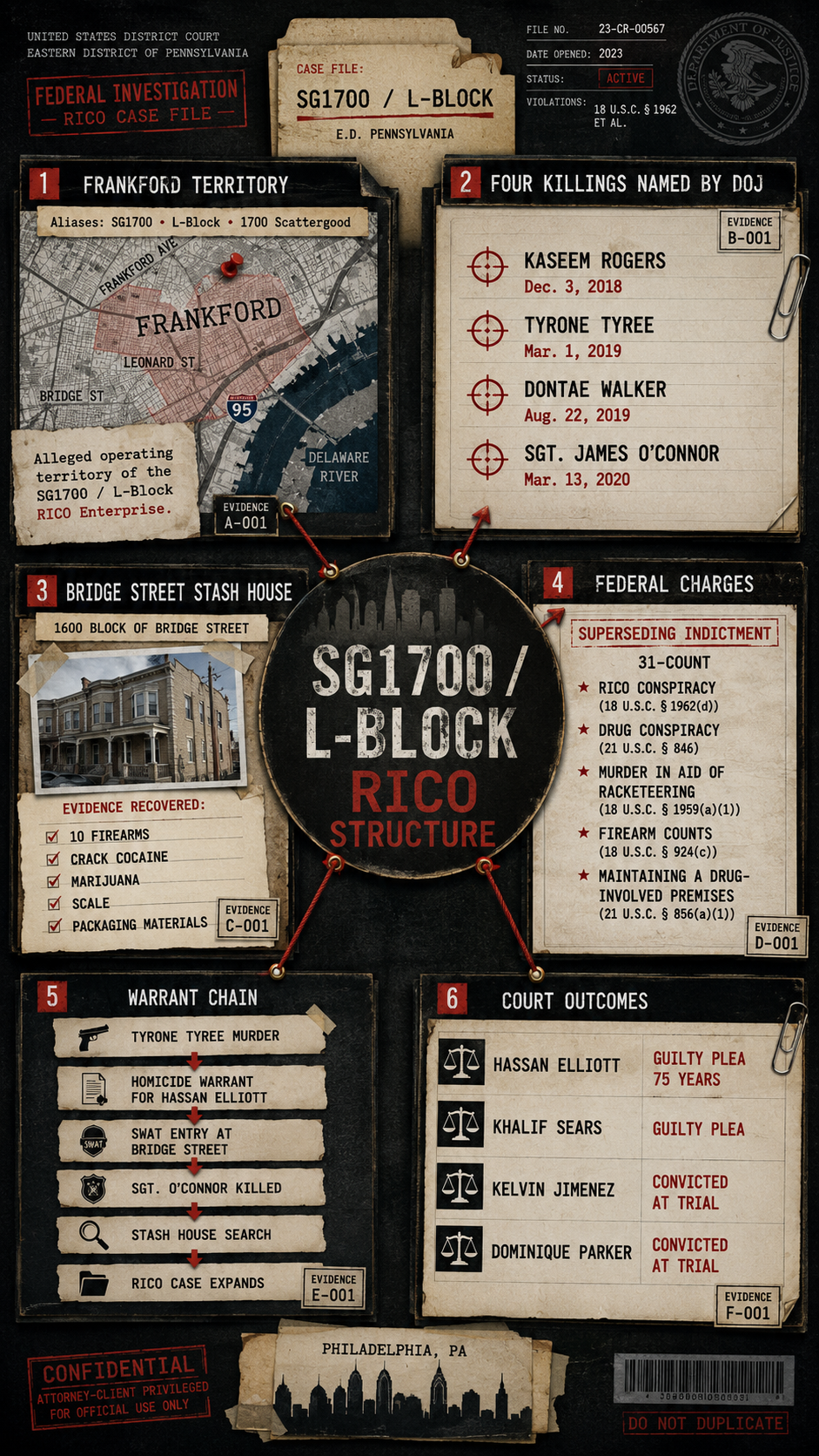
By the time the federal case reached its later stage, the government was no longer only prosecuting the March 2020 killing of Sgt. O’Connor. The superseding indictment turned the case into a broader racketeering file, charging a 31-count case that included RICO conspiracy, three additional murders, nine nonfatal shootings, drug conspiracy, firearm counts, and maintaining a drug-involved premises.
The Organization Prosecutors Named
Federal prosecutors described SG1700 / L-Block as a violent drug trafficking organization operating in Frankford. According to DOJ, members sold large quantities of narcotics over multiple years and used violence or threats of violence to protect their reputation and drug territory. That detail is the core of the RICO theory: the case was not built around one shooting alone, but around the government’s claim that shootings, murder, drugs, weapons, and stash-house activity were connected to the same enterprise.
The original 2020 indictment focused on Sgt. O’Connor’s killing and the drug-and-gun evidence connected to the Bridge Street property. ATF said that first indictment charged Hassan Elliott, also known as “Haz,” Bilal Mitchell, also known as “Omar” and “Walkdown,” Khalif Sears, also known as “Leaf” and “Lil Leaf,” and Sherman Easterling, also known as “Foot” and “Foot on da gas.” The later 2023 superseding indictment named Elliott, Sears, Kelvin Jimenez, also known as “Nip,” and Dominique Parker, also known as “Dom,” in the expanded RICO case.
The Four Killings Named In The Federal File
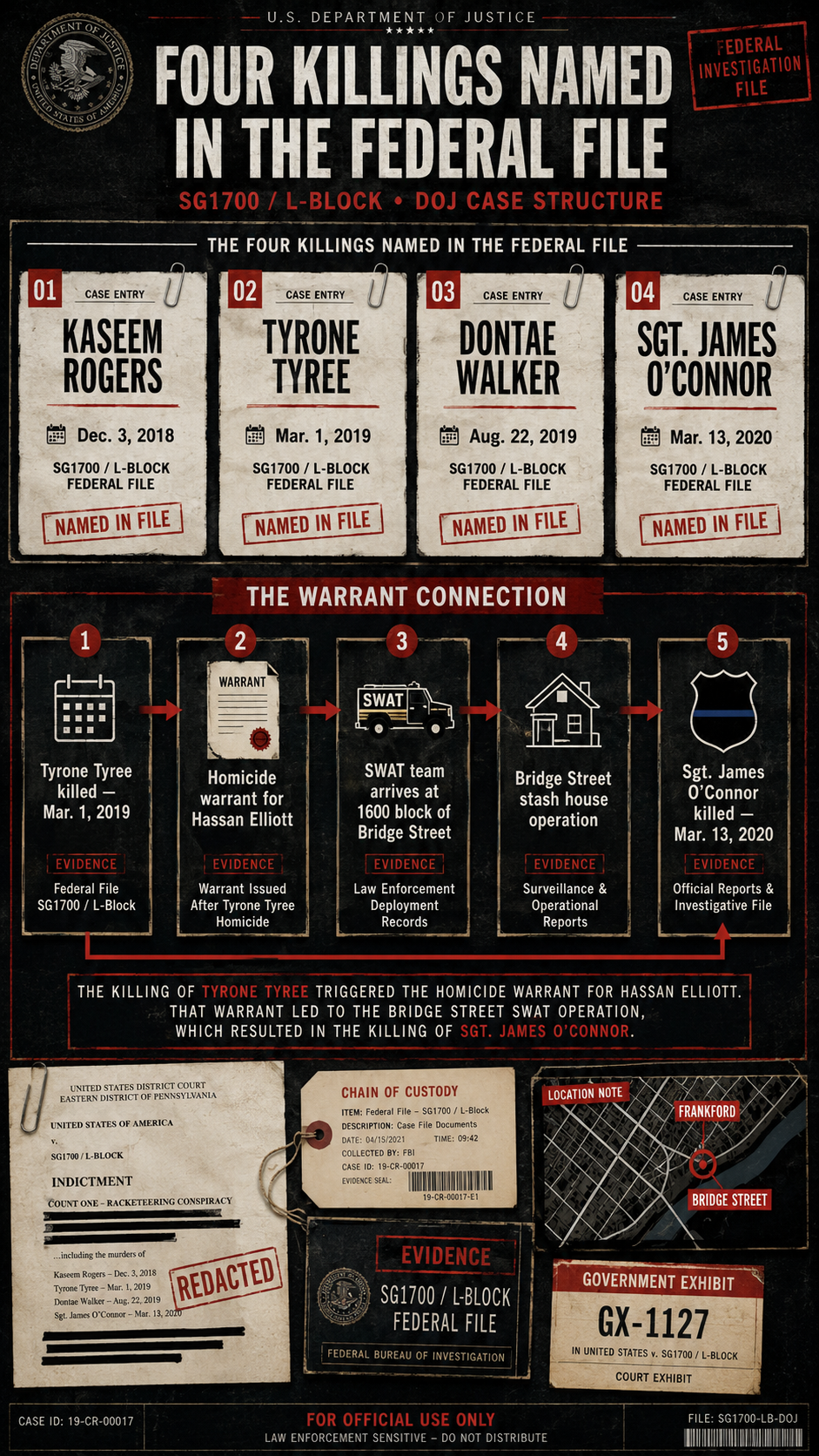
The federal file identifies four killings as central to the SG1700 / L-Block prosecution. Prosecutors alleged that Elliott and others killed Kaseem Rogers on December 3, 2018, Tyrone Tyree on March 1, 2019, and Dontae Walker on August 22, 2019. The fourth killing came on March 13, 2020, when Sgt. James O’Connor was shot during the SWAT operation at the Bridge Street stash house.
The case takes on a different weight because the fourth killing was tied directly to the attempted arrest for one of the earlier killings. DOJ says Sgt. O’Connor and other members of the Philadelphia Police Department SWAT team arrived at the 1600 block of Bridge Street with a homicide warrant for Elliott connected to the March 2019 killing of Tyrone Tyree.
The Timeline
December 3, 2018 — Kaseem Rogers killed. Federal prosecutors alleged that Elliott and others killed Kaseem Rogers as part of the SG1700 conspiracy. In the later trial result, DOJ said Kelvin Jimenez was convicted of the murder of Kaseem Rogers.
March 1, 2019 — Tyrone Tyree killed. DOJ says Tyrone Tyree was killed on March 1, 2019, and that the homicide warrant connected to Tyree’s killing is what brought SWAT officers to the Bridge Street property one year later.
August 22, 2019 — Dontae Walker killed. Federal prosecutors alleged that Elliott and others killed Dontae Walker in furtherance of the conspiracy. DOJ later said Dominique Parker was convicted of the murder of Dontae Walker.
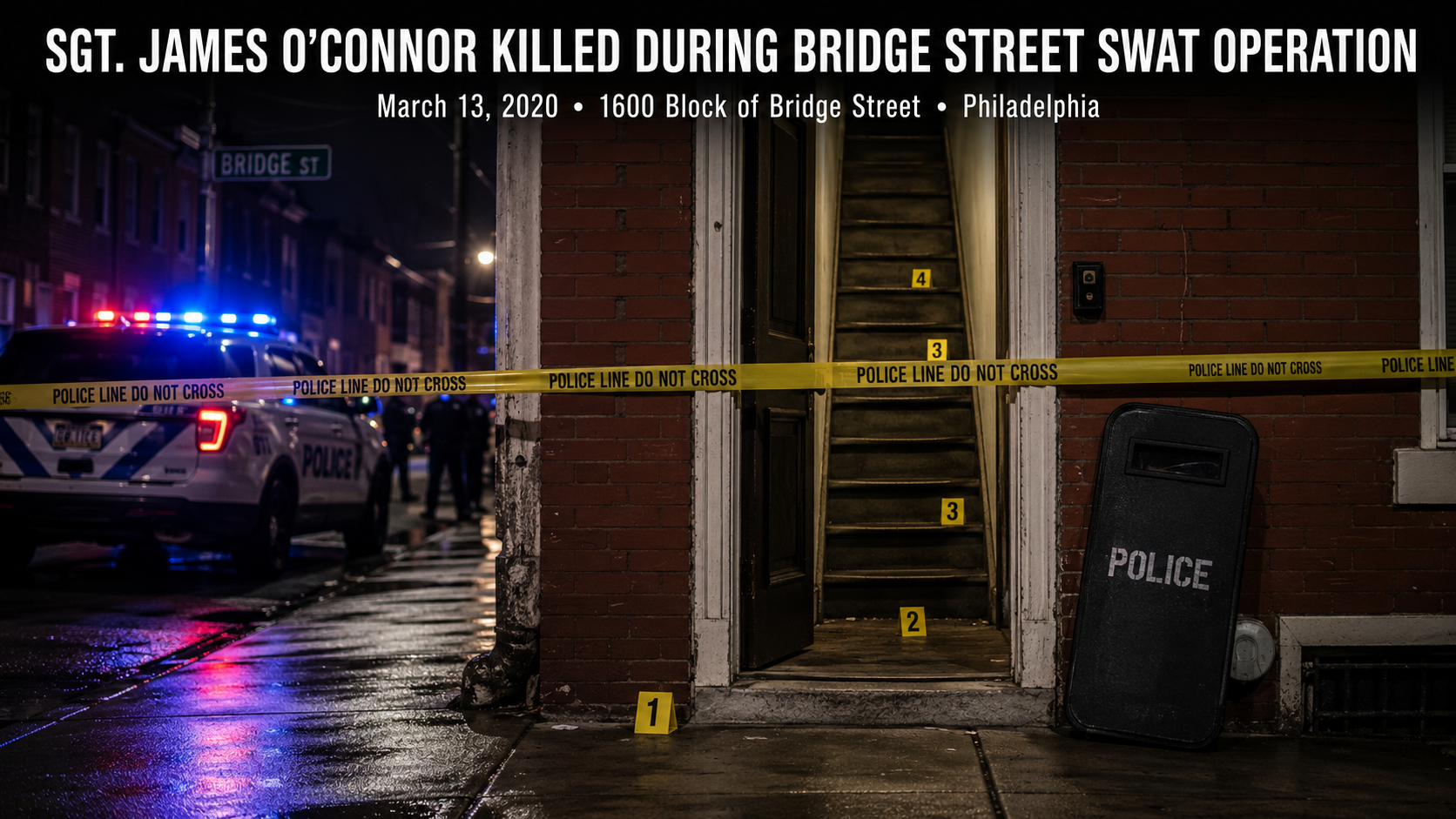
March 13, 2020 — Sgt. James O’Connor killed. DOJ says Elliott, Sears, and others previously indicted were inside the stash house when Sgt. O’Connor and other SWAT officers arrived. As officers went up the stairs and repeatedly announced their presence, Elliott fired a semiautomatic assault rifle 16 times, striking and killing Sgt. O’Connor.
December 10, 2020 — Original federal indictment announced. ATF said the original indictment charged four men in connection with Sgt. O’Connor’s death and related drug trafficking and firearms offenses. The indictment alleged the group operated as 1700 Scattergood and maintained a stash house with firearms, drugs, and drug packaging materials.
March 31, 2023 — Superseding indictment unsealed. DOJ announced the 31-count superseding indictment, expanding the case into a RICO prosecution with additional murder counts, nine nonfatal shootings, and related drug and gun charges.
January 2025 — Elliott and Sears plead guilty. DOJ says Elliott and Sears pleaded guilty to RICO conspiracy, drug trafficking conspiracy, causing Sgt. O’Connor’s death by firearm, and multiple drug, gun, and violent offenses.
March 2025 — Jimenez and Parker convicted at trial. DOJ says Jimenez and Parker were convicted of all charges against them, including racketeering conspiracy, drug trafficking conspiracy, maintaining a drug-involved premises, assaults in aid of racketeering, firearms offenses, and related crimes. Jimenez was also convicted of Kaseem Rogers’ murder, while Parker was convicted of Dontae Walker’s murder.
July 23, 2025 — Elliott sentenced to 75 years. Hassan Elliott was sentenced to 900 months in prison, five years of supervised release, and a $2,500 special assessment for the fatal shootings of Sgt. O’Connor, Kaseem Rogers, Tyrone Tyree, Dontae Walker, and additional crimes tied to SG1700 / L-Block.
The Bridge Street Stash House
The Bridge Street location is the center of the case because it connects the murder warrant, the drug operation, the firearms, and the killing of Sgt. O’Connor in one place. ATF said the defendants allegedly sold narcotics from a stash house in the 1600 block of Bridge Street, where they kept an arsenal of weapons, drugs, and drug paraphernalia.
On March 13, 2020, Sgt. O’Connor and other SWAT officers arrived with arrest and search warrants. DOJ later described the warrant as a homicide warrant for Elliott tied to the March 2019 killing of Tyrone Tyree. As officers moved up the staircase and announced themselves, Elliott fired 16 rounds from a semiautomatic assault rifle, killing Sgt. O’Connor.
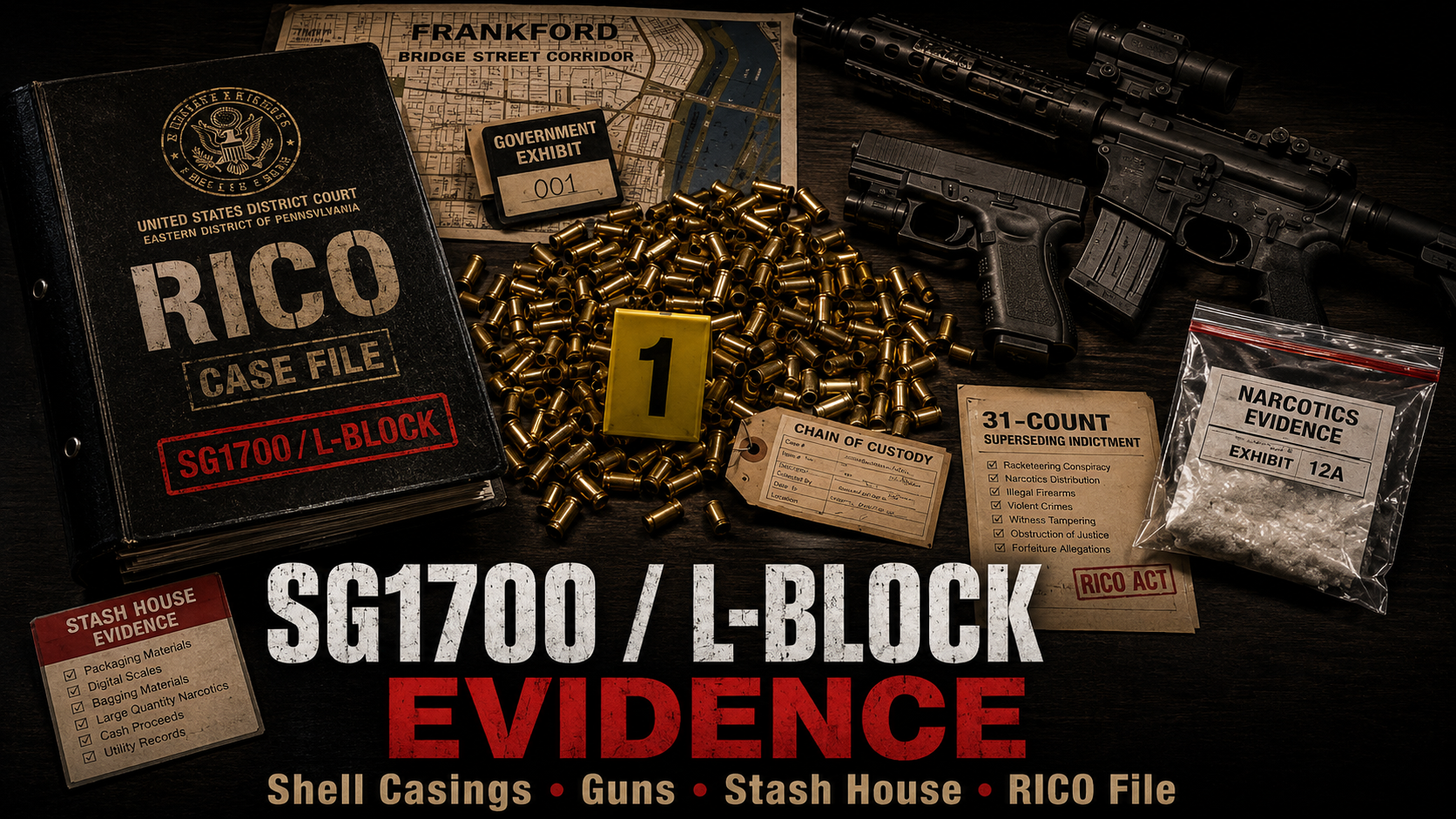
The search after the shooting gave prosecutors the physical evidence that made the stash-house part of the case concrete. ATF said investigators recovered 10 firearms, bulk and packaged crack cocaine, bulk and packaged marijuana, a scale, and packaging materials. That evidence tied the location to both firearms and drug distribution, not just the shooting that happened when police arrived.
The Evidence
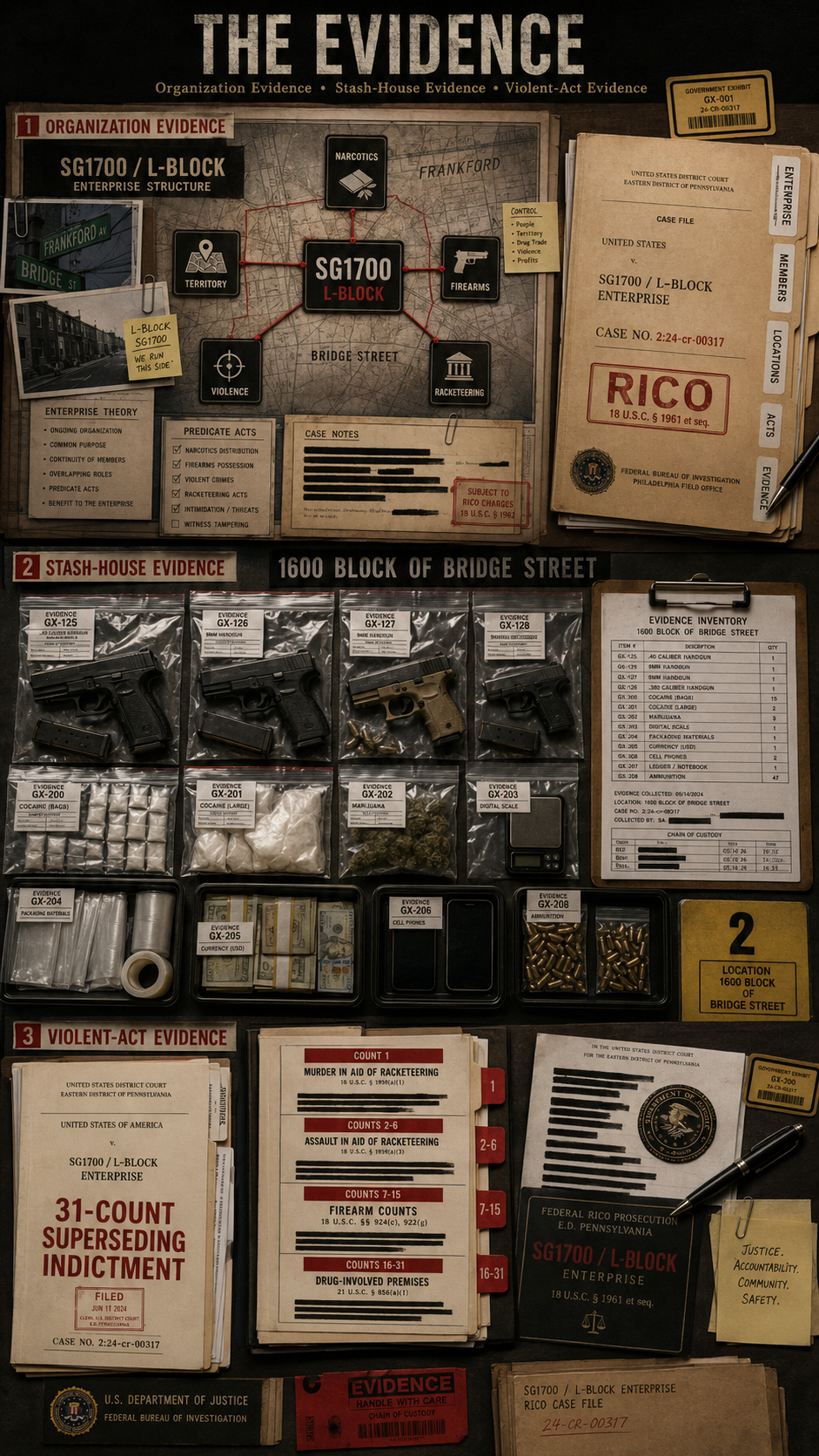
The strongest official evidence publicly described in the DOJ and ATF releases falls into three main categories: the organization evidence, the stash-house evidence, and the violent-act evidence.
The organization evidence came through the federal RICO theory. Prosecutors alleged SG1700 / L-Block was not just a loose group of individuals, but an enterprise that sold narcotics, protected drug territory, and used violence to maintain control. At trial, DOJ said Jimenez and Parker were proven to be part of SG1700 and were convicted on racketeering, drug, firearm, and assault-related charges.
The stash-house evidence came from the 1600 block of Bridge Street. ATF said the post-shooting search uncovered 10 firearms, crack cocaine, marijuana, a scale, and packaging materials. That turned the residence into more than a location where a police sergeant was killed; in the government’s case, it became a physical anchor for the drug-involved premises charge.
The violent-act evidence was built into the superseding indictment. DOJ said the 31-count indictment included four murder-in-aid-of-racketeering counts, nine assault-in-aid-of-racketeering counts, two attempted assault-in-aid-of-racketeering counts, firearm counts tied to crimes of violence, murder counts tied to firearm use, drug charges, and felon-in-possession counts.
The Charges
The superseding indictment charged all four defendants with one count of RICO conspiracy and one count of drug conspiracy. Additional charges included murder in aid of racketeering, assault in aid of racketeering, attempted assault in aid of racketeering, possession of a firearm in furtherance of drug trafficking, using or discharging a firearm during a crime of violence, murder during firearm use, possession with intent to distribute and distribution of controlled substances, maintaining a drug-involved premises, and possession of a firearm by a felon.
The indictment also carried Notices of Special Findings for Elliott on each of the four murder-while-using-or-carrying-a-firearm charges. At the indictment stage, those notices made Elliott eligible for the death penalty if convicted. DOJ also included its standard warning that an indictment is only an accusation and defendants are presumed innocent unless proven guilty.
The Trial And Convictions
By March 2025, the case had split into guilty pleas and trial convictions. Elliott and Sears pleaded guilty in January to RICO conspiracy, drug trafficking conspiracy, causing Sgt. O’Connor’s death by firearm, and multiple drug, firearm, and violent offenses. Jimenez and Parker went to trial and were convicted of all charges against them.
DOJ’s trial release is important because it separates the roles. Jimenez and Parker were convicted as part of SG1700’s drug and violence structure. Jimenez was convicted of the murder of Kaseem Rogers. Parker was convicted of the murder of Dontae Walker. The same release says Jimenez and Parker were part of the conspiracy that led to Sgt. O’Connor’s killing, while Elliott was the person DOJ says fired the rifle during the Bridge Street SWAT operation.
A Philadelphia Inquirer report added another layer from the trial: Jimenez and Parker were not accused of being present for Sgt. O’Connor’s killing, but prosecutors argued they were leaders who helped supply drugs and weapons to younger members and helped members avoid apprehension. That reporting matches the RICO structure: prosecutors did not need to prove every defendant personally pulled every trigger to argue the violence advanced the enterprise.
The Sentence
On July 23, 2025, Hassan Elliott received 900 months in federal prison, equal to 75 years. DOJ said the sentence covered the fatal shootings of Sgt. James O’Connor, Kaseem Rogers, Tyrone Tyree, Dontae Walker, and additional drug, gun, and violent crimes tied to Elliott’s membership in SG1700 / L-Block.
The sentencing release locks in the final posture for Elliott: guilty plea, federal sentence, supervised release, special assessment, and a court record that ties his punishment to all four named killings. It also confirms that SG1700 / L-Block was treated by the government as a violent drug trafficking organization operating in Frankford, not simply as a single homicide case.
Official Facts Versus Allegations
The confirmed court outcomes are clear. Elliott and Sears pleaded guilty. Jimenez and Parker were convicted at trial. Elliott was sentenced to 75 years. Jimenez was convicted of Kaseem Rogers’ murder, and Parker was convicted of Dontae Walker’s murder.
The allegations from the superseding indictment still matter because they explain how prosecutors built the full case, but indictment language should be separated from convictions. The 2023 indictment alleged the broader SG1700 / L-Block structure, the additional murders, the nonfatal shootings, and the violent-drug-territory motive. The later guilty pleas, trial convictions, and sentencing are what moved major parts of that case from allegation into proven or admitted federal outcomes.
What Makes This Case File Strong
The case has multiple layers that make it stronger than a simple “gang indictment” write-up. The first layer is the Bridge Street stash house: a location tied to a homicide warrant, a fatal SWAT shooting, firearms, drugs, and packaging material. The second layer is the RICO expansion: prosecutors connected the O’Connor killing to three earlier homicides and multiple shootings. The third layer is the outcome: guilty pleas, trial convictions, and a 75-year sentence.
The most powerful angle is that the killing of Sgt. O’Connor did not start the federal story — it exposed the rest of it. The warrant came from Tyrone Tyree’s murder. The search uncovered the stash-house evidence. The later indictment reached backward to Kaseem Rogers, Tyrone Tyree, and Dontae Walker. By the end, the government had turned a fatal warrant operation into a full racketeering case against SG1700 / L-Block.