
Reporting and analysis may discuss allegations and online theories. Allegations are not findings of guilt. Verify important details in the cited public record.
The Case File
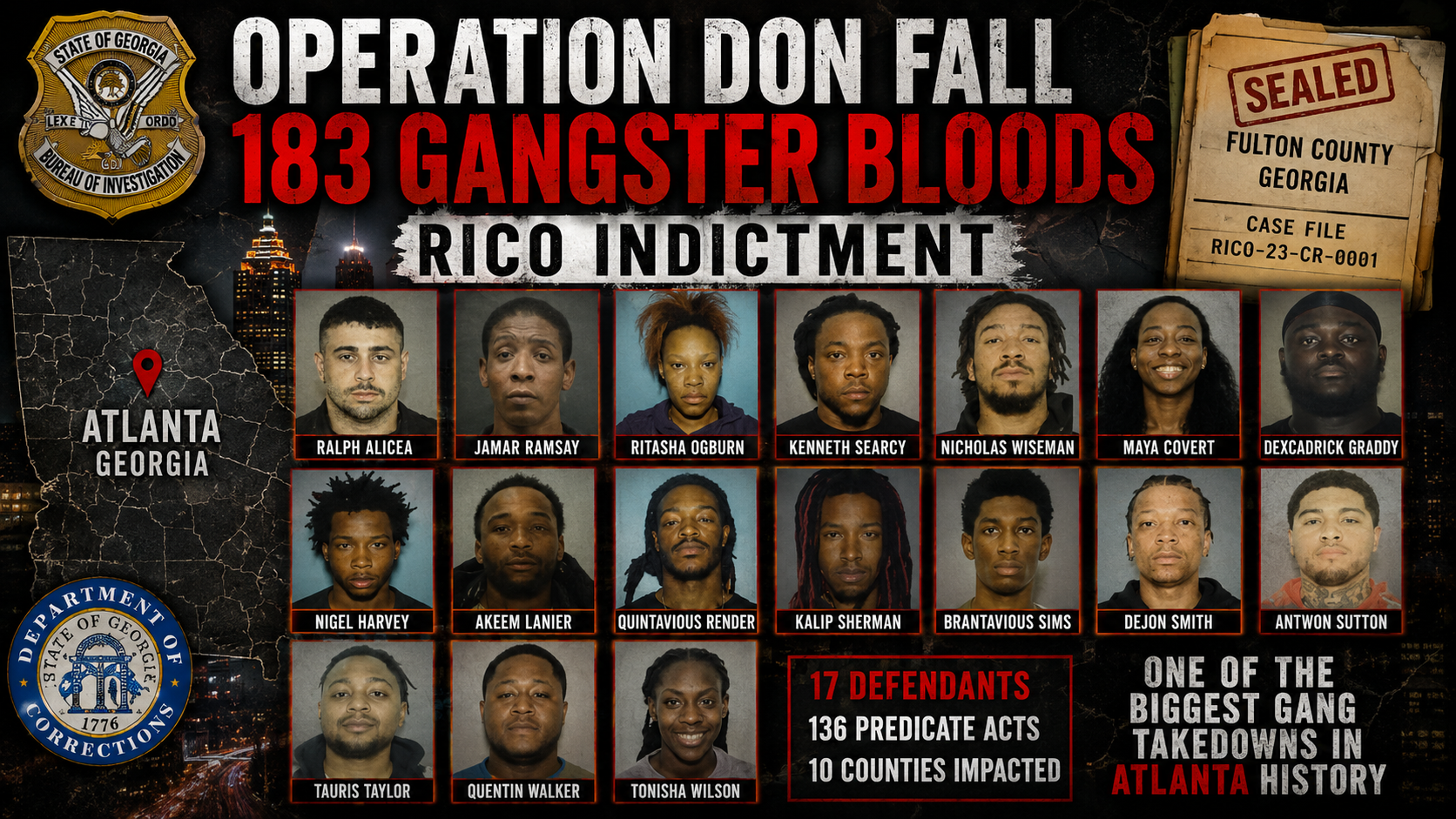
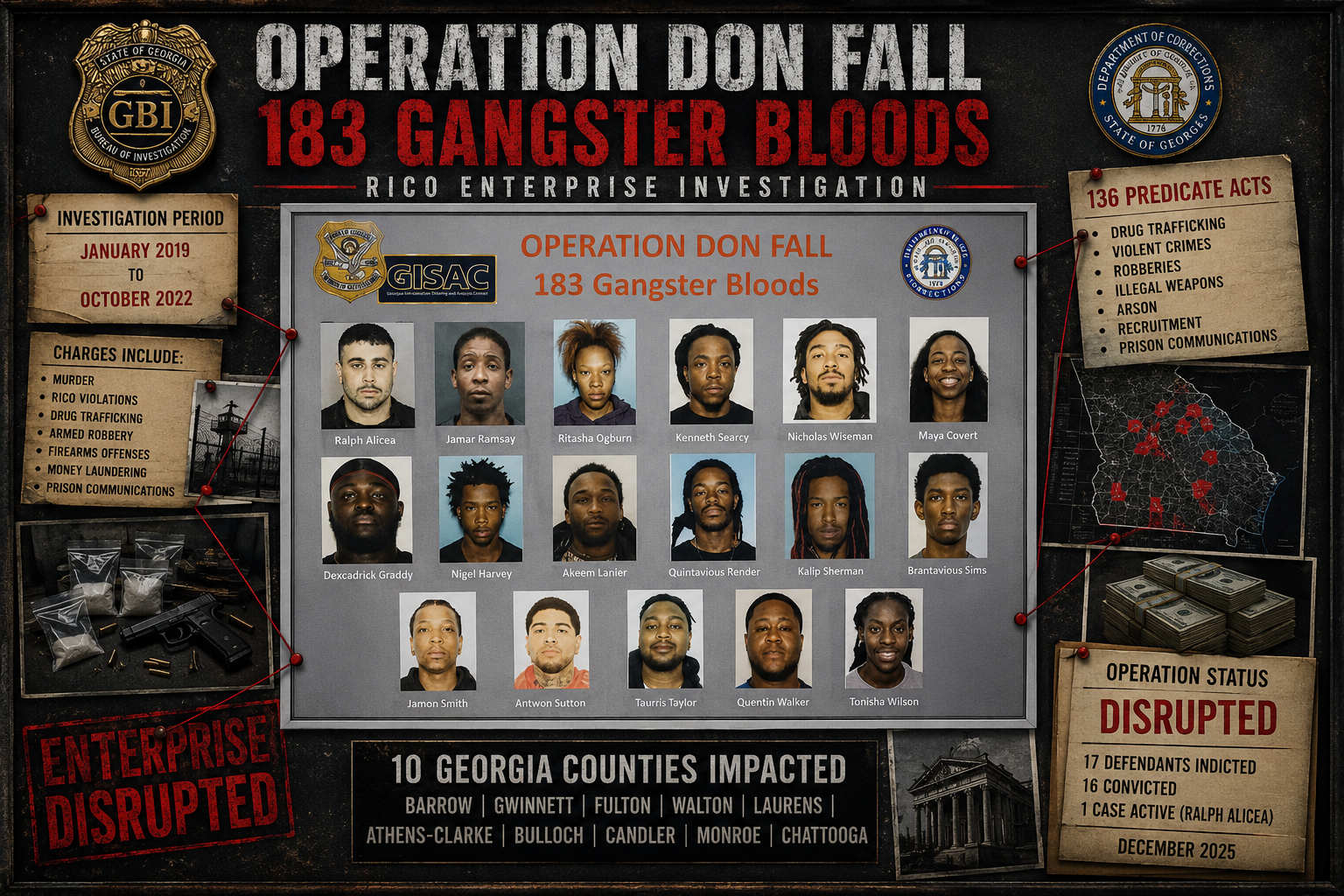
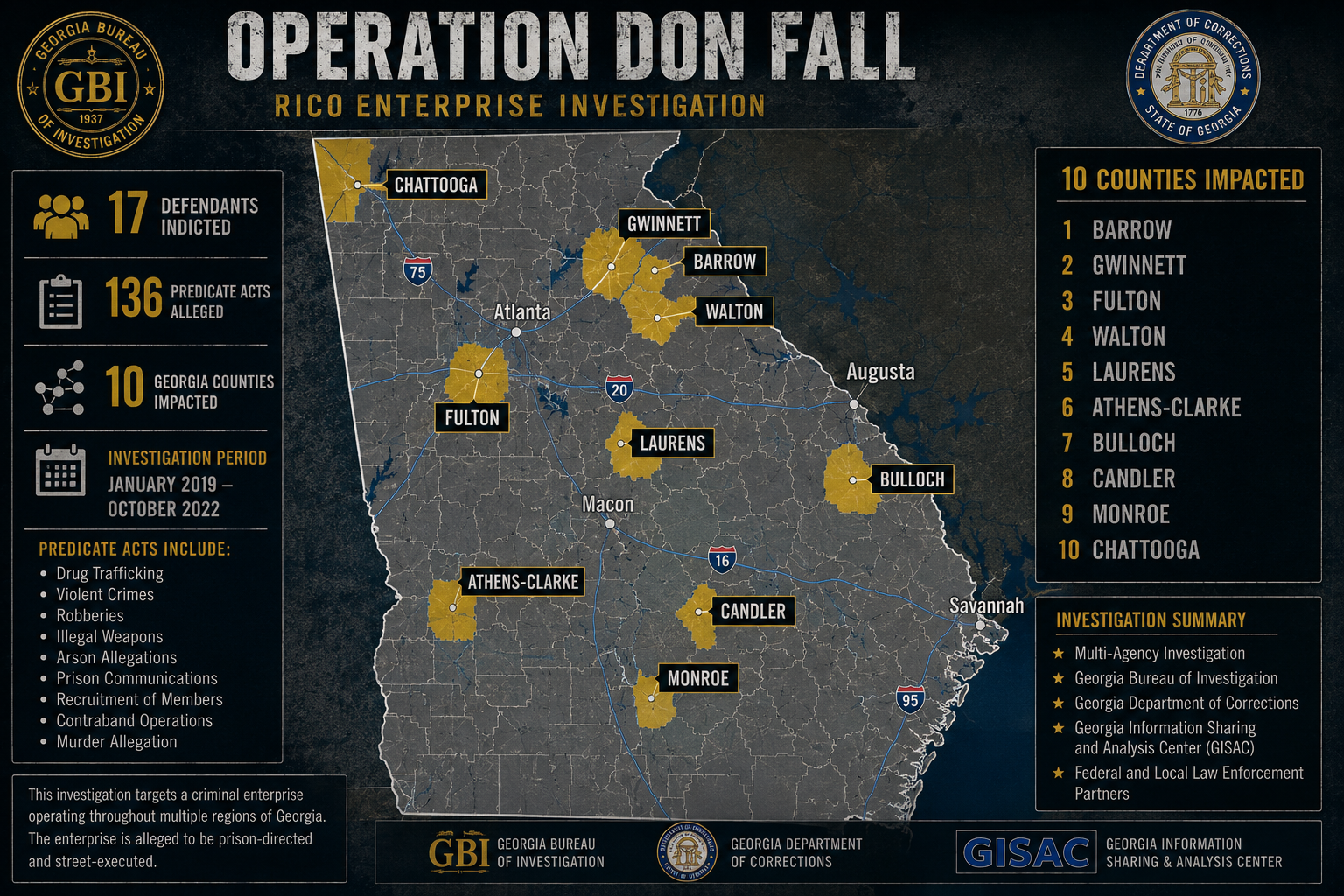
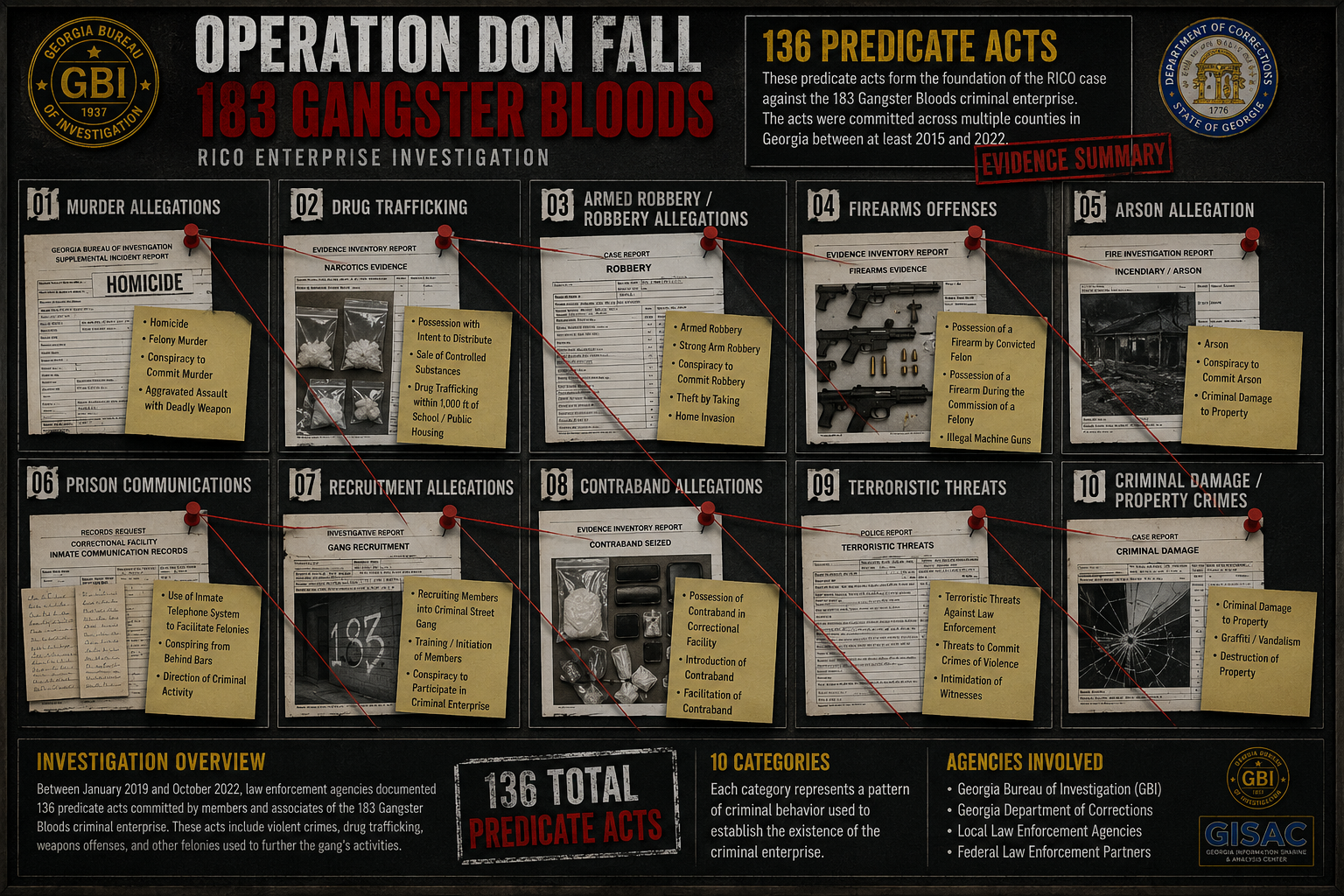
This case did not start like a normal street indictment. It started with Georgia investigators saying a gang network was moving through prisons, phones, neighborhoods, drug markets, recruitment events, and violence across multiple counties, while two alleged leaders were already behind bars. By the time the state announced the case, 17 alleged members of the 183 Gangster Bloods, also known as 1-8 Trey Gangster Bloods, were tied to a RICO indictment built around 136 alleged predicate acts. The file stretched from January 2019 to October 2022 and reached Athens-Clarke, Barrow, Bulloch, Candler, Chattooga, Fulton, Gwinnett, Laurens, Monroe, and Walton counties.
The Enterprise
The 1-8 Trey Gangster Bloods are described by Georgia officials as a Bloods set that originated in the Bronx and became part of the United Blood Nation. In Georgia’s case, prosecutors alleged the enterprise was built around obtaining money, weapons, property, influence, territory, and reputation through racketeering activity. The indictment claimed the group used violence, threats, drug distribution, robberies, recruitment, internal discipline, dues, and social media promotion to strengthen the organization.
The names at the top made the case different. Ralph Alicea, also known as “MK,” was listed as an alleged national leader while in custody at Attica State Prison in New York. Jamar Ramsay, also known as “Supreme,” was listed as an alleged Georgia statewide leader while in custody at Hays State Prison. Prosecutors alleged that leadership did not stop at the prison gate, and that orders, recruitment, money movement, contraband discussions, and gang communication continued through electronic contact from inside custody.
Operation Don Fall
The investigation was called Operation Don Fall. It was built by the Georgia Bureau of Investigation’s Gang Task Force and the Georgia Department of Corrections’ Office of Professional Standards Investigative Division and Security Threat Group Unit. The Attorney General’s Gang Prosecution Unit presented the case to a Barrow County grand jury on October 25, 2022, and the indictment was publicly announced days later.
The original indictment charged all 17 defendants with Conspiracy to Violate Georgia’s RICO Act. The state said the alleged conspiracy included murder, aggravated assault, armed robbery, fentanyl trafficking, methamphetamine trafficking, cocaine trafficking, marijuana trafficking, firearms offenses, terroristic threats, criminal damage to property, and arson.
The Prison Command Allegation
The prison angle became the spine of the case. Prosecutors later said Ramsay used electronic communication to discuss recruitment, contraband, drug distribution inside Hays State Prison, money transactions, and active gang conflicts. One of the most disturbing allegations centered on youth recruitment, with officials saying Ramsay and others discussed targeting younger people and using community-style events as a doorway into the gang.
In one cited May 2022 communication, Nicholas Wiseman allegedly discussed buying neighborhood kids ice cream and planning a cookout. Prosecutors framed that as part of a larger recruitment strategy, not a random favor or neighborhood event. That detail gives the case one of its strongest premium angles because the indictment was not only about street violence. It was about how investigators believed the organization tried to grow.
The Murder Charge
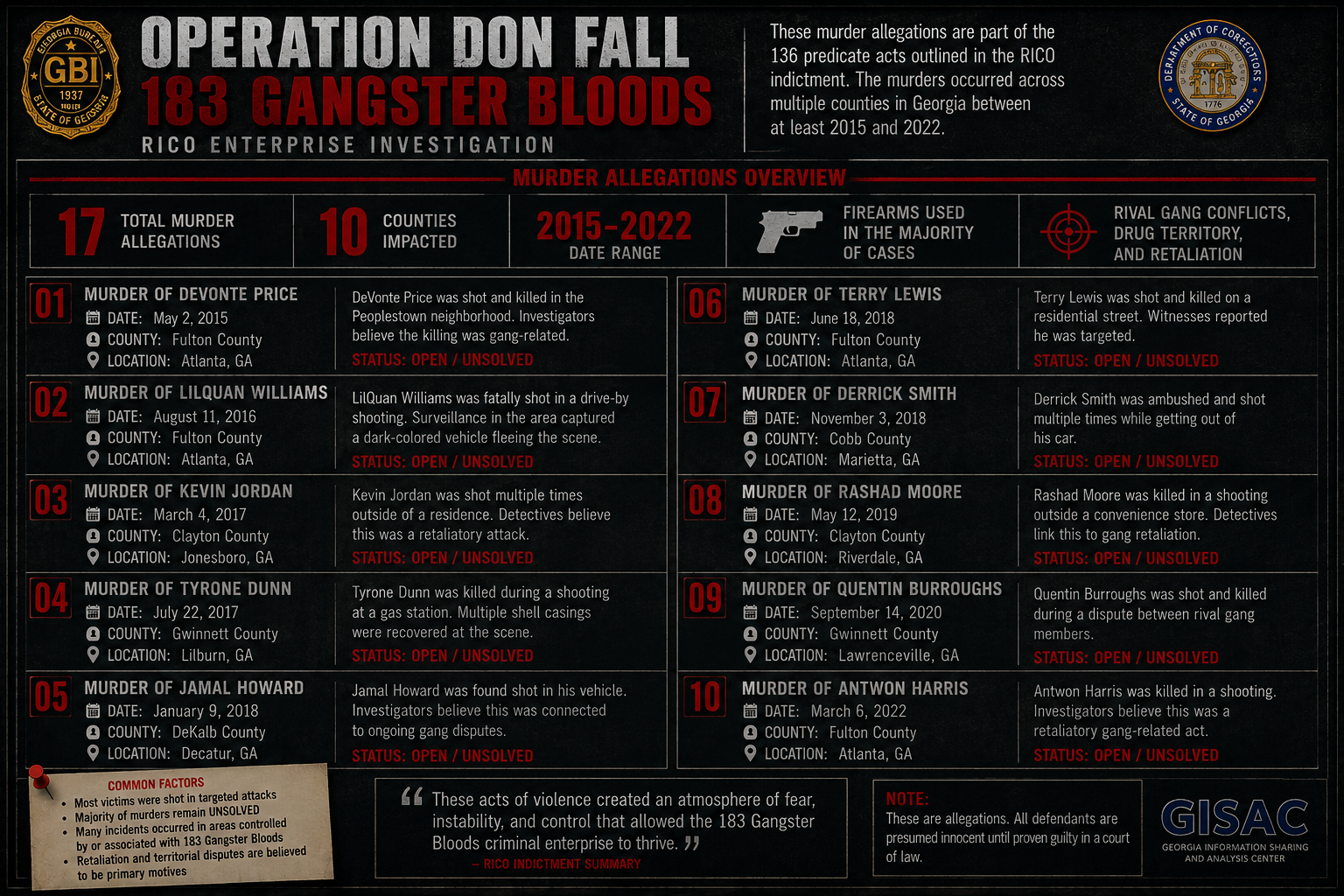
The murder allegation centered on Brantavious Sims, also known as “Trap” or “BJ.” Prosecutors said Sims fatally shot Lane Bullard in Barrow County in April 2022. Sims was originally charged with murder, two counts of felony murder, aggravated assault with a deadly weapon, gang charges, purchase of marijuana, and possession of a firearm during the commission of a felony.
That homicide became one of the violent anchors inside the wider RICO file. Prosecutors also alleged that in April 2022, Sims and Nicholas Wiseman communicated by text about acquiring a firearm from a rival gang through robbery. The case later claimed Sims’ homicide was discussed through the Securus electronic call platform, including what the killing meant for 1-8 Trey and debts allegedly owed by Sims to Wiseman.
The Arson In Laurens County
Another unusual section of the case was the Laurens County arson allegation. FOX 5 reported that the indictment tied Akeem Lanier and Dexcadrick Graddy to a previously unsolved arson in Laurens County from June 14, 2020. Later, Georgia officials described the allegation as first-degree arson in Dublin, claiming Lanier and Graddy knowingly caused, encouraged, and hired another person to set fire to a home and vehicle.
That allegation gives the file a wider criminal range than a basic gang sweep. The state was not only describing shootings or drugs. It was building a pattern that crossed into property destruction, intimidation, and coordinated acts allegedly tied to the enterprise.
The Drug And Contraband Pipeline
The indictment alleged drug activity both outside prison and inside correctional facilities. Outside prison, prosecutors pointed to fentanyl, methamphetamine, cocaine, and marijuana cases across multiple counties. Inside the prison system, officials said Ramsay and other defendants discussed packaging and shipping cell phones, tobacco, controlled substances, and other contraband into a state correctional facility.
Dexcadrick Graddy was tied to trafficking methamphetamine, cocaine, and fentanyl in Laurens County in February 2021. Quentin Walker Jr. was tied to unlawful fentanyl possession in Laurens County in July 2021. Nigel Harvey was tied to cocaine sales and counterfeit substances in Barrow County. Antwon Sutton was tied to marijuana trafficking in Fulton County, cocaine sales in Barrow County, and obtaining a stolen firearm.
The Violence Outside Prison
The state’s later conviction summary listed multiple violent acts outside prison. In June 2019, Ramsay was accused of aggravated assault using a homemade weapon against Jermaine Young and Durell Lewis, causing serious bodily injury. In July 2022, Nigel Harvey was accused of shooting at Jarvis Roberson in Athens-Clarke County. In August 2022, Harvey was accused of taking an iPhone and money by force or fear in Riverside, California.
Those incidents expanded the case beyond Georgia’s county map. The indictment timeline already covered Georgia counties from metro Atlanta to Laurens County, but the later conviction summary added California into the broader pattern of conduct. Prosecutors used the file to show a network that did not operate like one crew on one block, but like a scattered structure connected by communication, allegiance, orders, and money.
The Defendant Board
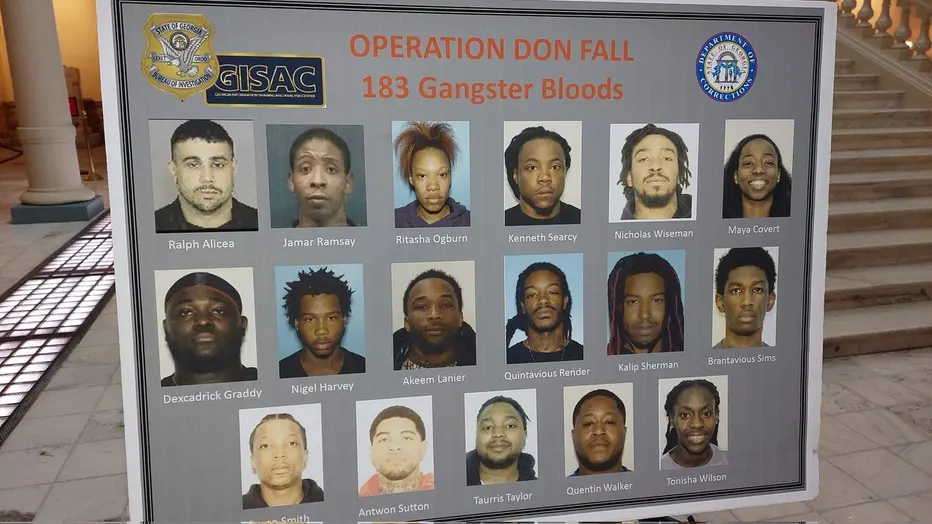
The original indictment named Ralph Alicea, Jamar Ramsay, Nicholas Wiseman, Taurris Taylor, Nigel Harvey, Maya Covert, Brantavious Sims, Kenneth Searcy, Akeem Lanier, Quintavius Render, Dexcadrick Graddy, Quentin Walker Jr., Ritasha Ogburn, Tonisha Wilson, Kalip Sherman, Aaaron Smith, and Antwon Sutton. Prosecutors identified Alicea as an alleged national leader and Ramsay as an alleged Georgia statewide leader.
By December 2025, Georgia Attorney General Chris Carr announced that 16 members had been convicted. Ramsay was convicted after a 20-day jury trial and sentenced to an additional 60 years in prison. Sims was convicted after the same trial and sentenced to life without the possibility of parole plus 25 years. The remaining convicted defendants entered pleas over roughly two years. Ralph Alicea’s case was described as active and ongoing, with officials still calling him an alleged national leader.
Convictions And Sentences
Jamar Ramsay, also known as “Supreme,” was convicted of RICO conspiracy and five counts of violating the Street Gang Terrorism and Prevention Act. He received an additional 60-year prison sentence. Brantavious Sims, also known as “Trap” or “BJ,” was convicted of RICO conspiracy, malice murder, felony murder, aggravated assault, gang charges, firearm possession during a felony, and purchase of marijuana. He received life without parole plus 25 years.
Nicholas Wiseman pleaded guilty in October 2025 and received 40 years, with the first 25 years to be served in prison. Nigel Harvey pleaded guilty in July 2024 and received 20 years, with the first 15 years to serve. Dexcadrick Graddy pleaded guilty in January 2024 and received 15 years, with the first 10 years to serve. Antwon Sutton pleaded guilty in April 2025 and received 20 years, with the first 10 years to serve.
Other defendants received a mix of prison time and strict probation. Taurris Taylor received 15 years with the first 3 years to serve. Maya Covert received 15 years of strict probation. Kenneth Searcy received 10 years with the first 2 years to serve. Akeem Lanier received 15 years with the first 10 years to serve. Quintavius Render received 15 years with the first 4 years to serve. Quentin Walker Jr. received 20 years with the first 8 years to serve. Ritasha Ogburn and Tonisha Wilson each received 10 years with the first year to serve. Kalip Sherman received 20 years with the first 5 years to serve. Aaron Smith and Antwon Sutton were also listed among the convicted defendants.
Official Facts Versus Open Questions
The official record is strongest on the indictment, the named defendants, the counties involved, the charged conduct, the later convictions, and the sentences announced by the Georgia Attorney General’s Office. The state also publicly described specific communications involving recruitment, contraband, violence, drug distribution, and prison leadership. Those details are part of the official prosecution summary, not social media rumor.
The public record is thinner on the full investigative file. The case references electronic messages, Securus calls, texts, drug cases, prison contraband discussions, and violent acts, but most of the raw documents, exhibits, message logs, and trial testimony are not laid out in full inside the public press releases. That leaves room for a premium case file to separate the public conviction summary from the deeper unanswered pieces: who communicated with who, how often, what evidence tied each defendant to each act, and how prosecutors arranged 136 acts into one RICO theory.
Final Breakdown
The 183 Gangster Bloods file is not powerful because 17 names were announced at a podium. It is powerful because the state claimed the structure kept moving even when leadership was locked inside prison walls. The case connected a Bronx-rooted Bloods set to Georgia counties, prison phones, youth recruitment allegations, fentanyl, cocaine, meth, marijuana, arson, robberies, shootings, and a murder conviction that ended with life without parole.
By the end, prosecutors said 16 defendants were convicted, one alleged national leader still had an active case, and the organization had been disrupted through a RICO prosecution built around 136 acts. The story begins as an indictment, but the real case file is about command, communication, recruitment, and how investigators said a prison cell became part of the street operation.


