

Reporting and analysis may discuss allegations and online theories. Allegations are not findings of guilt. Verify important details in the cited public record.
The Night on Bonifant Street
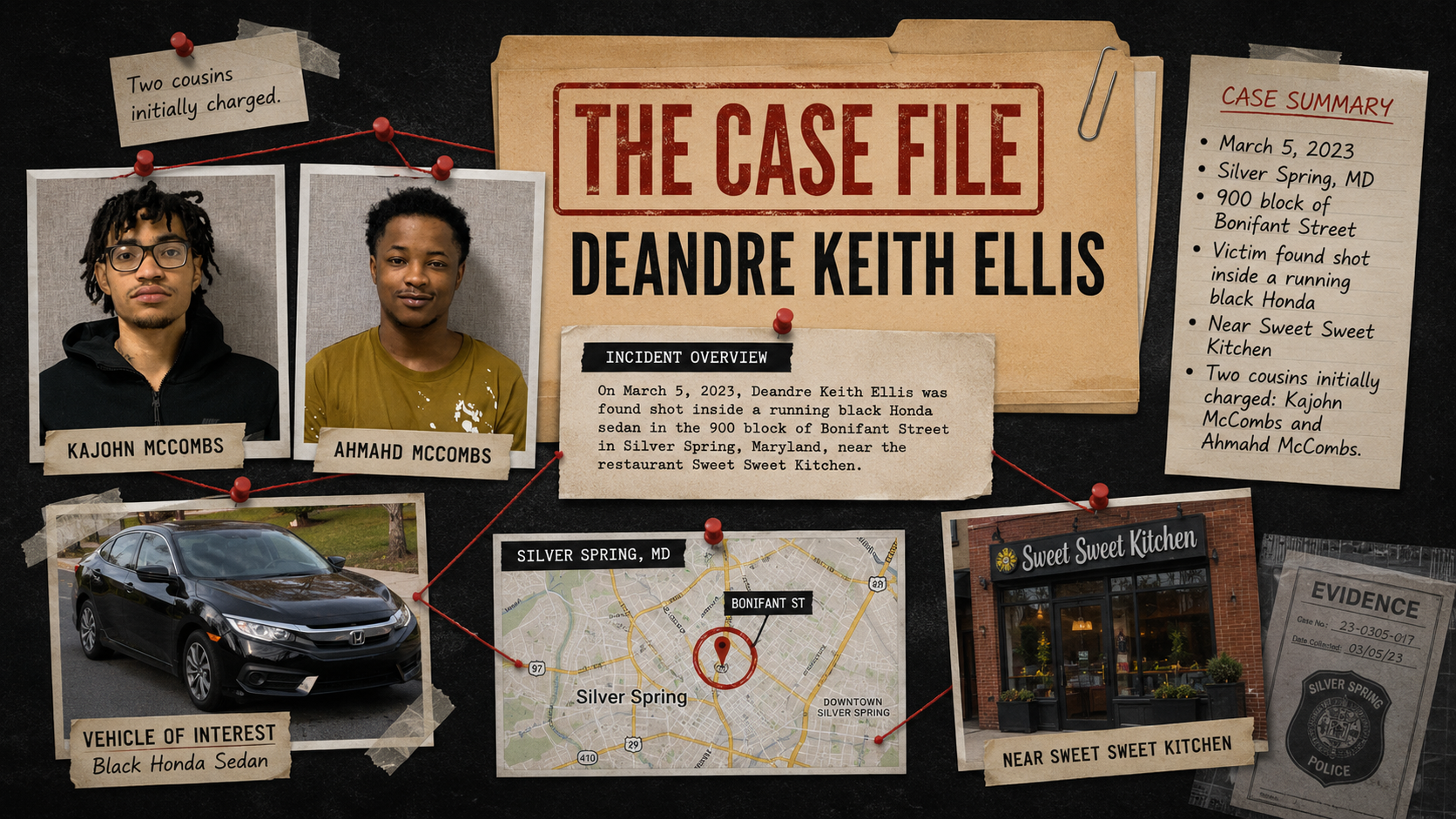
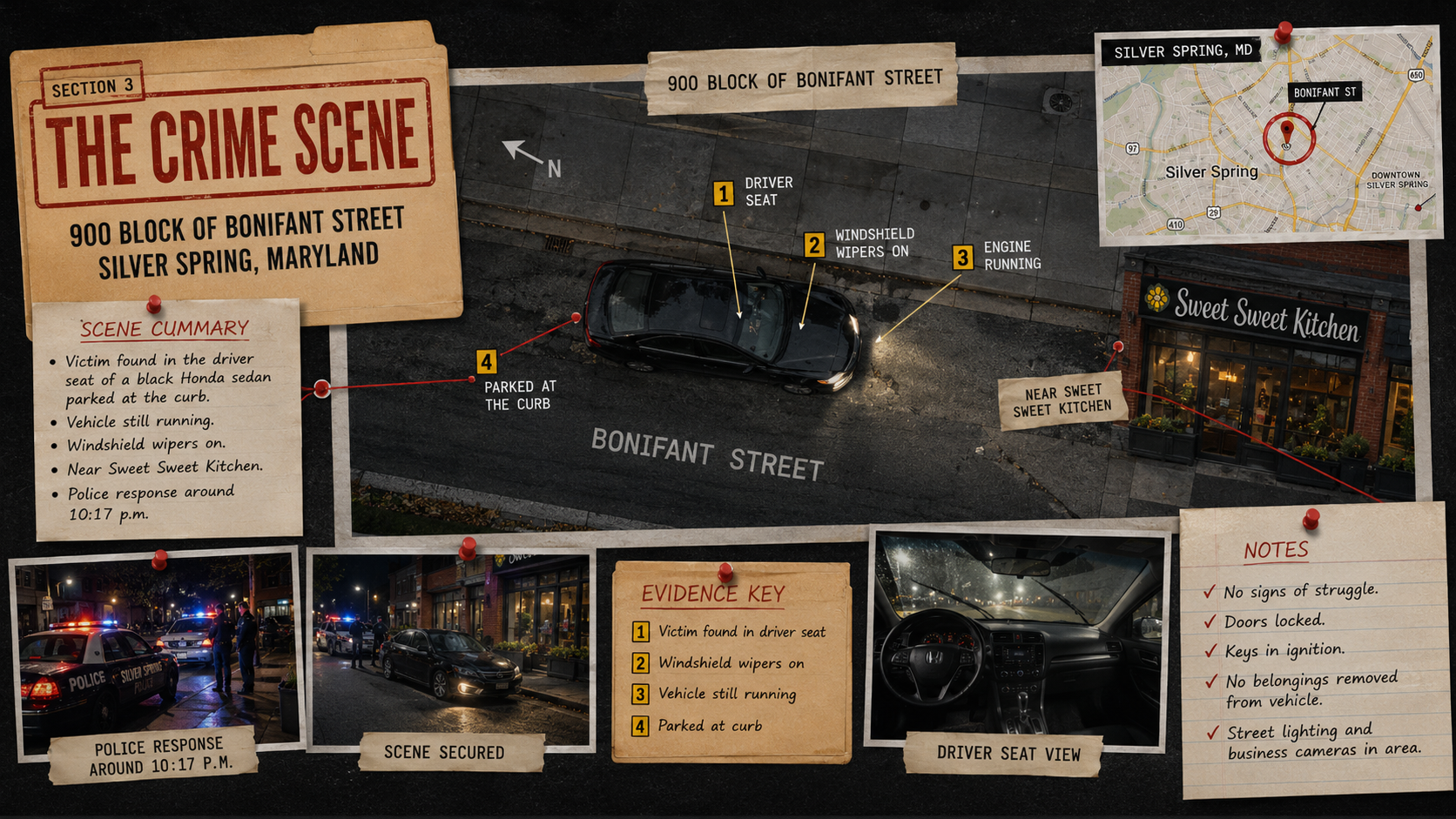
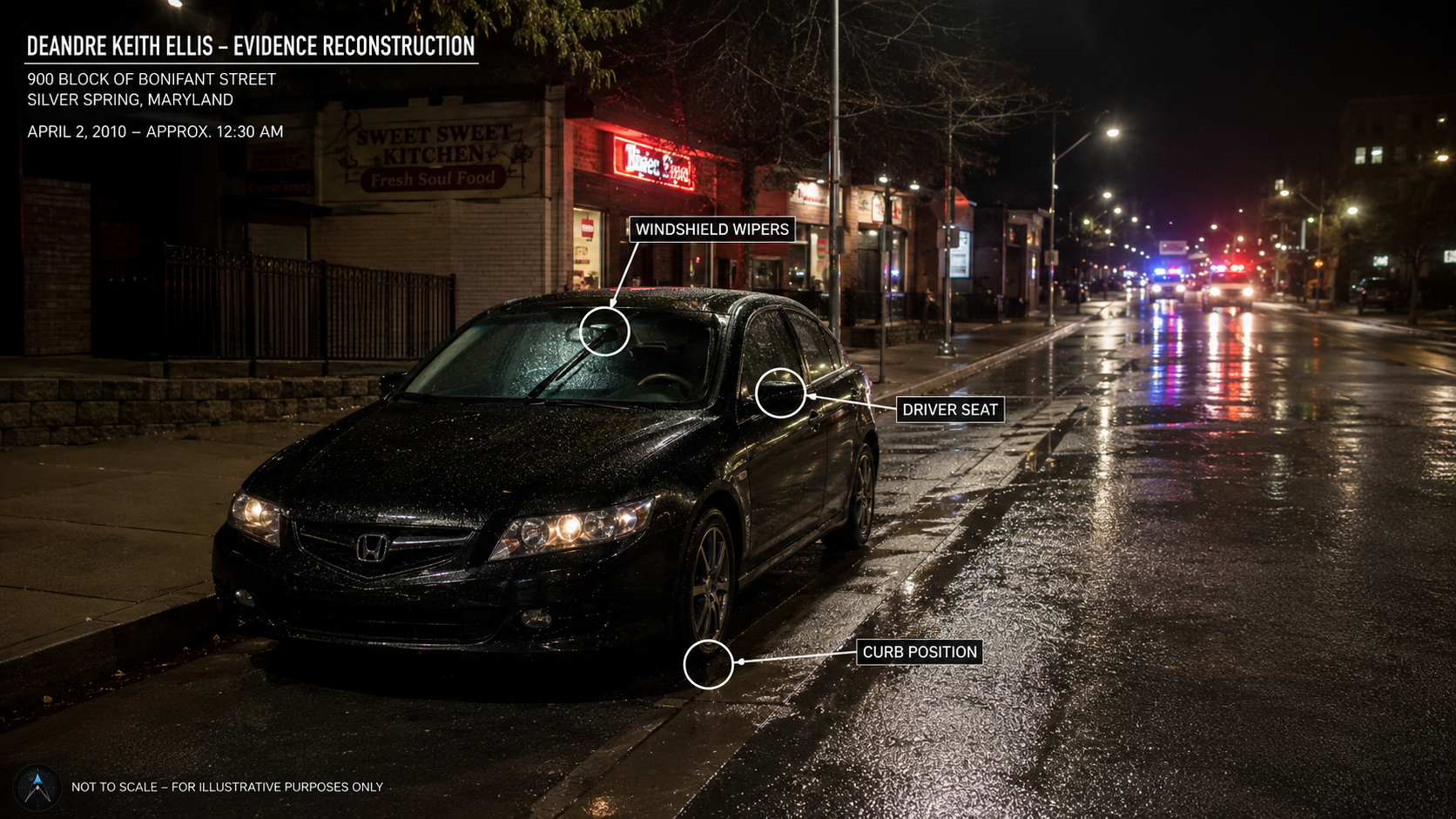
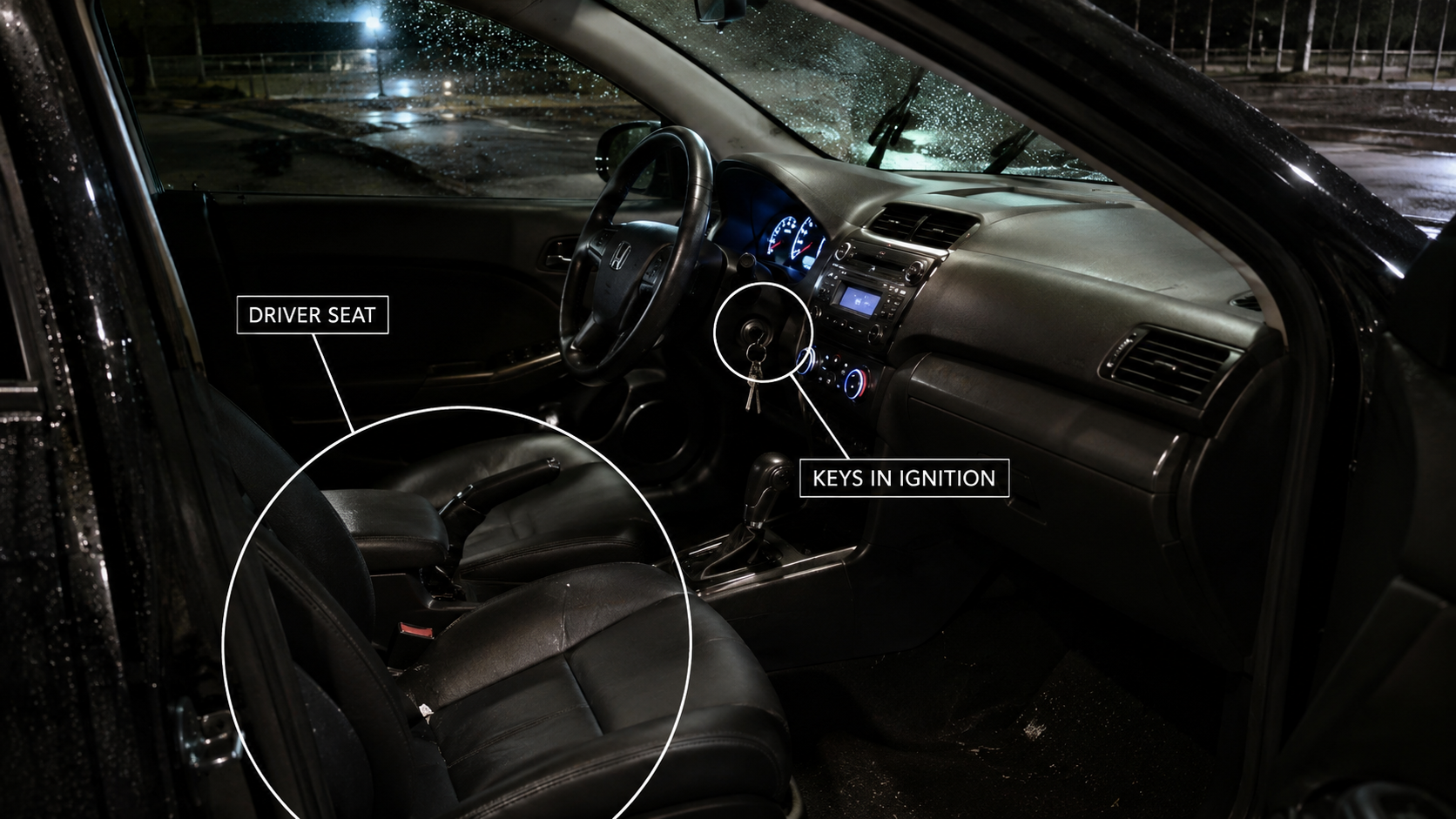
At approximately 10:17 p.m. on March 5, 2023, what began as a welfare check in downtown Silver Spring turned into a homicide investigation. Montgomery County officers were sent to the 900 block of Bonifant Street after an off-duty D.C. police officer noticed a man apparently unconscious behind the wheel of a black Honda Accord. The vehicle was still running, and its windshield wipers continued moving across the glass. Inside the driver’s seat was 23-year-old Deandre Keith Ellis.
Police determined that Ellis had been shot. Montgomery County’s initial public statement was brief, confirming only that officers found him deceased inside the vehicle with an apparent gunshot wound and that Major Crimes detectives had taken over the investigation.
Later court reporting provided a more disturbing reconstruction. Prosecutors said Ellis had been shot from behind, with one projectile passing through his neck and another entering near the base of his skull.
The location was eventually identified more specifically as the area outside Sweet Sweet Kitchen on Bonifant Street. Nothing in the first police announcement revealed a known motive, identified a shooter, or explained why Ellis had ended up dead behind the wheel of a running car. The investigation instead began with the contents of the Honda, the people believed to have been around it, and a piece of digital evidence detectives allegedly found on the passenger-side floor.
Inside the Honda

The interior of the vehicle gave investigators several different directions to examine. According to court-record reporting, the off-duty officer who first noticed Ellis also saw what appeared to be bottles associated with “Lean,” a term commonly used for mixtures involving codeine and promethazine. Investigators reportedly recovered a prescription ledger from Ellis’s pocket containing names and pharmacy references, and detectives suspected the material could relate to fraudulent acquisition or resale of prescription drugs.
That suspicion never became a publicly established motive for the killing. The available record does not prove that Ellis was shot over prescription medication, a drug debt, a robbery, or any specific transaction. The ledger may have influenced investigative thinking, but the public evidence reviewed for this file does not connect it directly to the moment someone opened fire inside the Honda.
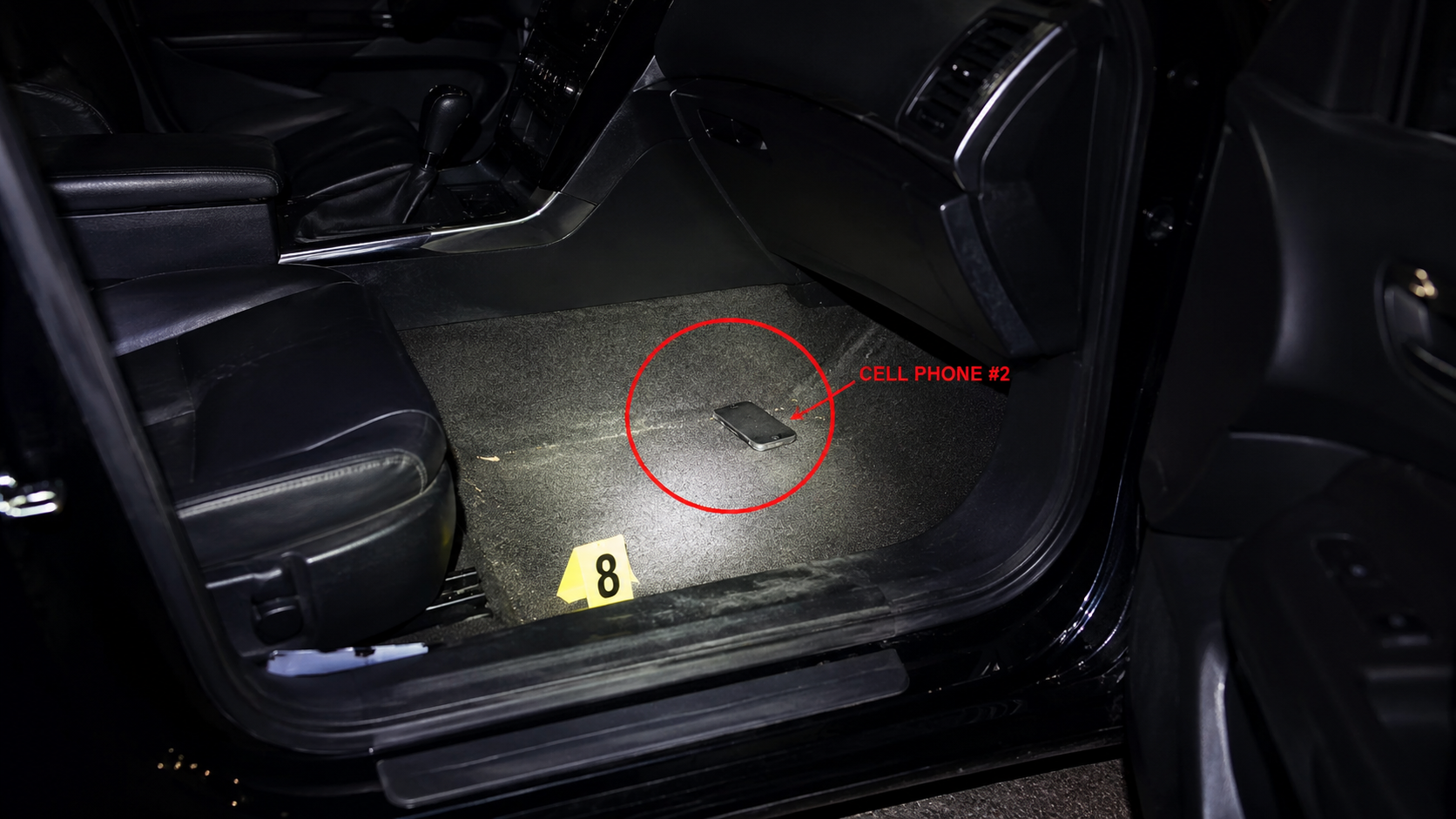
More important to the homicide case were two phones recovered from the vehicle. One was found near Ellis and was believed to belong to him. The second, according to court filings described in contemporary reporting, was located on the front passenger-side floorboard. Investigators alleged that phone records and fingerprints connected the device to Kajohn McCombs.
The placement of that second phone quickly became one of the most consequential details in the entire case. Detectives were no longer dealing only with a dead man in a parked vehicle. They believed they had recovered a device associated with a future murder defendant from inside the same car where Ellis had been shot from behind.
The Phone on the Passenger Floorboard
Police did not treat the second device as an isolated object. Their theory depended on what allegedly happened after the shooting. According to court-record reporting, investigators said a phone associated with Ahmahd McCombs was used to call Kajohn McCombs’s phone after people fled the Honda. Detectives interpreted that communication as an attempt to locate the missing device, reasoning that someone may have realized the phone had been left behind inside the murder car.
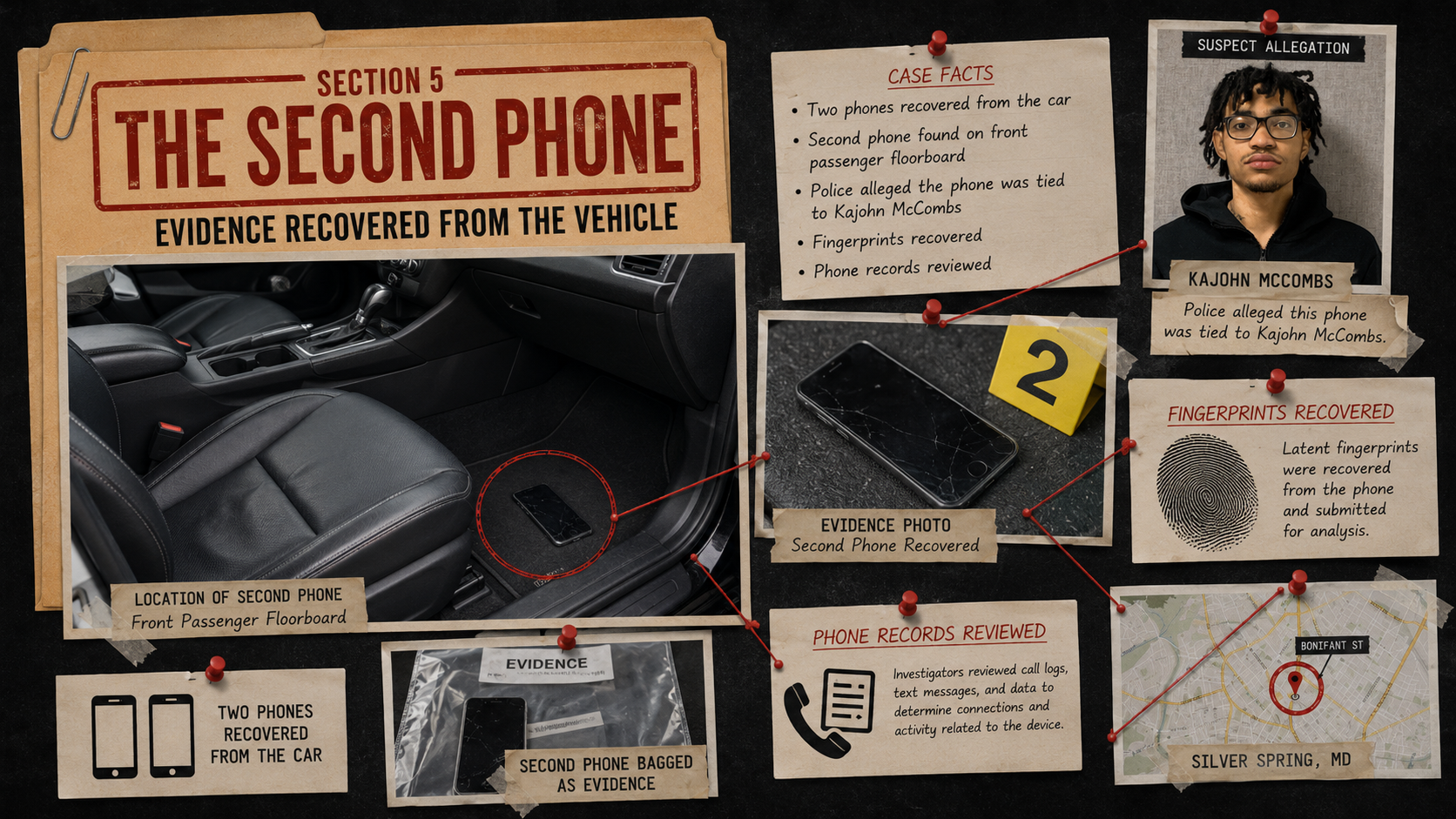
That sequence became central to the State’s early theory. A phone allegedly tied to Kajohn through records and fingerprints was found on the passenger floorboard, then another phone associated with his cousin allegedly called it after the shooting. Taken together, investigators believed those facts helped connect the men to the vehicle and to the moments surrounding Ellis’s death.
The evidence was powerful enough to shape an arrest theory, but its limits were equally important once the case moved toward trial. A phone can establish association with a device. Fingerprints can support proof that someone handled it. Call records can document communication between numbers. None of those facts automatically identify who fired a weapon, establish when every person entered or exited the car, or prove that each person present shared an agreement to kill Ellis.
That distinction would become one of the defining tensions of the prosecution.
What the Surveillance Reportedly Showed
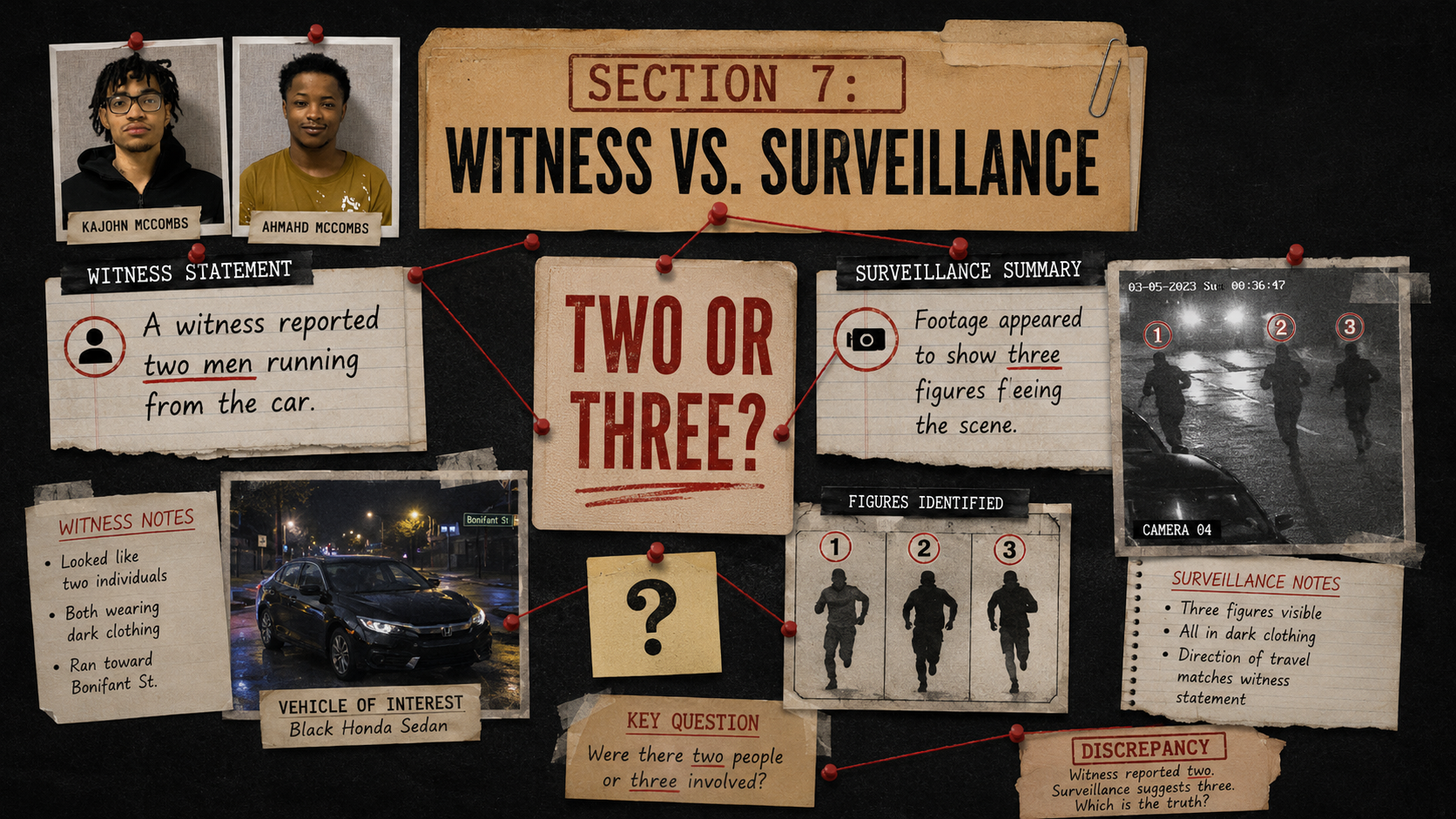
The movement around the Honda produced another complication. A witness reportedly told investigators that two men were seen running from the vehicle. Surveillance footage, however, was described as showing three people fleeing.
The public record does not provide enough raw footage or witness detail to determine exactly why those accounts differed.
A witness may have missed someone, viewed only part of the escape, or seen the movement from an angle different from the camera. The surveillance may also have captured separate departures that were not obvious to someone watching from the street. What can be established is that the early investigation contained a discrepancy between the number of people described by a witness and the number reportedly visible on video.
That difference became more significant as the case expanded. In March 2023, investigators were publicly described as still looking for another suspect after the first two arrests. By the end of the following year’s investigative cycle, four men had been accused in connection with the homicide. The public record therefore never resolved into a simple equation where every figure on surveillance neatly matched every person eventually charged.
The footage appears to have helped detectives reconstruct movement around the scene, but the full video record has not been made publicly available in a form that allows an independent frame-by-frame reconstruction of who occupied which position, who left first, or who was carrying a weapon.
The First Two Arrests
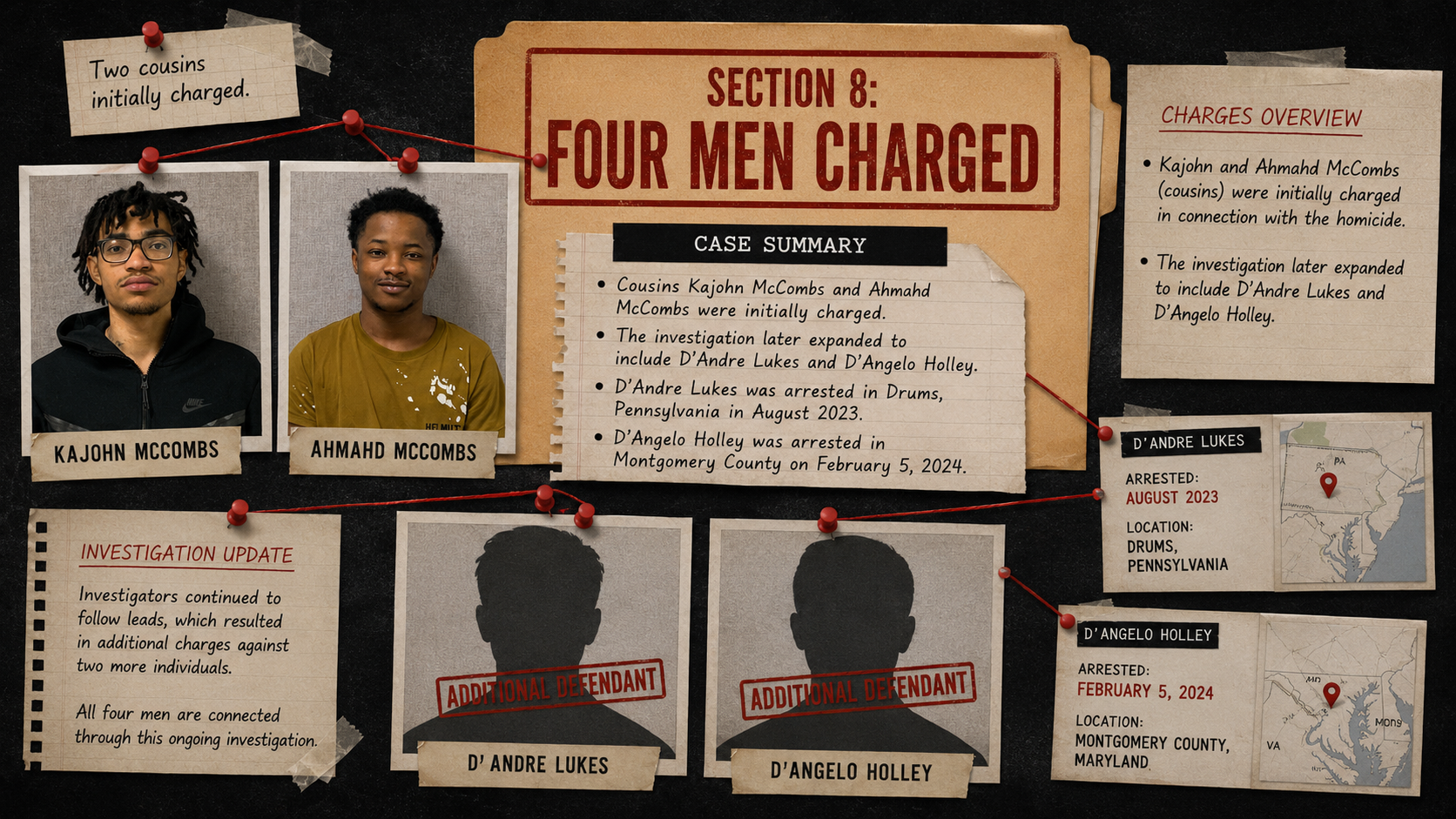
Nine days after Ellis was killed, detectives arrested Kajohn McCombs and Ahmahd McCombs. Both men were 22 years old at the time and were identified by police as being from Capitol Heights. They were charged with first-degree murder, and contemporary reporting described them as cousins.
The official arrest announcement revealed little about the evidence. Montgomery County police said detectives had developed the two men as suspects, obtained warrants, and taken them into custody. The deeper allegations emerged through later court proceedings, where the phone on the passenger floorboard, alleged fingerprints, phone records, and post-shooting call activity became part of the public case narrative.
Kajohn’s detention proceedings also brought attention to prior gun-related cases in Washington, D.C., which prosecutors referenced while arguing against release. Those earlier matters were relevant to the bond discussion but did not prove his involvement in Ellis’s killing. The murder prosecution still had to stand on evidence tied to Bonifant Street and the Honda itself.
At that stage, the case appeared to center on two relatives and one allegedly abandoned phone. The investigation continued for months, and when it widened, it did so without police publicly disclosing a new confession, a recovered murder weapon, or a confirmed motive.
From Two Defendants to Four
On October 19, 2023, detectives obtained first-degree-murder warrants for D’Andre Lukes and D’Angelo Holley. Montgomery County police announced the development in early November, stating that both men had been identified as suspects through the continuing investigation into Ellis’s death.
The new warrants changed the structure of the case. What had initially been presented publicly as a murder prosecution involving two cousins now included four accused men. Lukes was identified as being from Washington, D.C., while police listed no known address for Holley at the time of the announcement.
The department did not publicly explain which specific evidence caused investigators to add Lukes and Holley to the case. No official release identified a new eyewitness who had placed them inside the Honda, a newly recovered firearm linked to the bullets that killed Ellis, or a confession describing how the shooting unfolded. The public was told that the investigation had developed them as suspects, but the detailed evidentiary path behind those accusations remained largely outside view.
That gap matters because the prosecution was no longer simply trying to connect a lost phone to one man. It was now advancing a homicide theory broad enough to support murder charges against four different defendants.
D’Andre Lukes Is Located in Pennsylvania
Lukes was not arrested in Maryland. Montgomery County police later announced that he had been located in Drums, Pennsylvania, where Butler Township police took him into custody on the outstanding first-degree-murder warrant. He was held pending extradition.
The interstate arrest added another layer to the investigation but should not be exaggerated beyond the record. Police verified that Lukes was wanted and later found in Pennsylvania. The public sources reviewed for this case do not establish that he fled there specifically to avoid prosecution for Ellis’s homicide, and the location of his arrest cannot substitute for evidence of guilt.
By the time Lukes was in custody, three of the four accused men had been arrested. Holley remained outstanding until February 5, 2024, when police apprehended him in Montgomery County and served the first-degree-murder warrant.
Nearly eleven months after Ellis was found inside the running Honda, every publicly identified suspect was in custody.
The Passenger-Door DNA
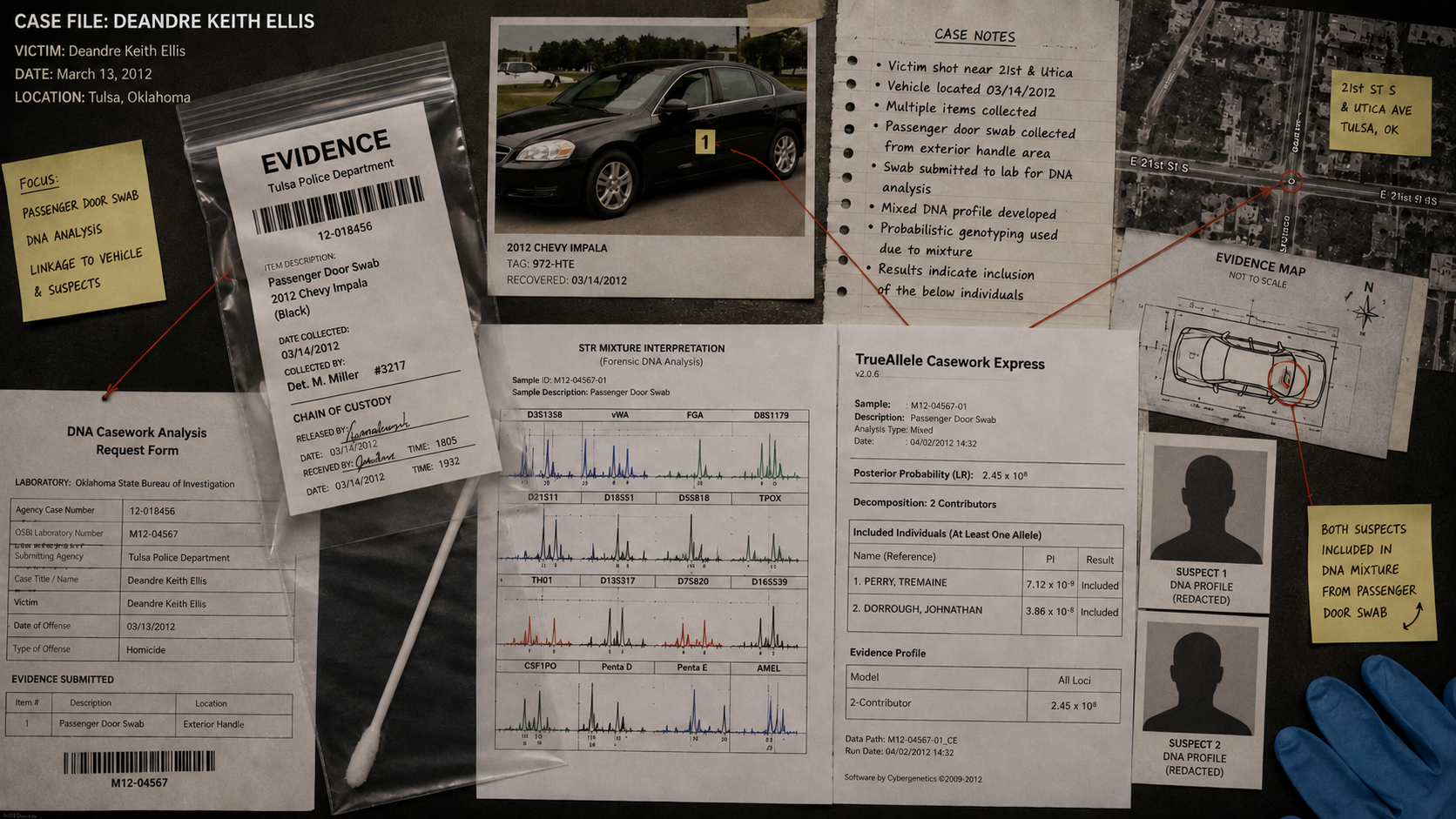
The investigation eventually developed a forensic layer beyond phones and surveillance. According to case summaries published by Cybergenetics, the company behind the TrueAllele probabilistic-genotyping system, investigators collected swabs from the vehicle and the Montgomery County Police Crime Laboratory generated DNA data from the passenger-door area.
The sample was complicated. Cybergenetics states that the police laboratory could not conventionally interpret the DNA mixture because of its complexity. That did not mean the sample contained no usable biological information. It meant the mixture could not be resolved through the laboratory’s ordinary interpretive process.
TrueAllele was then used to analyze the same underlying data. Cybergenetics reported inclusionary match statistics of approximately 6.71 thousand and 10 million involving two suspects. The company’s own published summaries are careful about who those results concerned. In its Kajohn McCombs case description, Cybergenetics says the reported statistics involved two other suspects rather than Kajohn. Its summary of the D’Angelo Holley matter likewise indicates that the inclusionary results concerned suspects other than Holley.
That distinction prevents the DNA from being reduced to a misleading headline. The publicly described results did not simply place Kajohn’s DNA on the passenger door or identify Holley as a contributor. Instead, the mixed sample became part of a larger prosecution theory involving multiple defendants, while the strongest reported inclusionary statistics concerned other accused men.
What the DNA Added to the Case
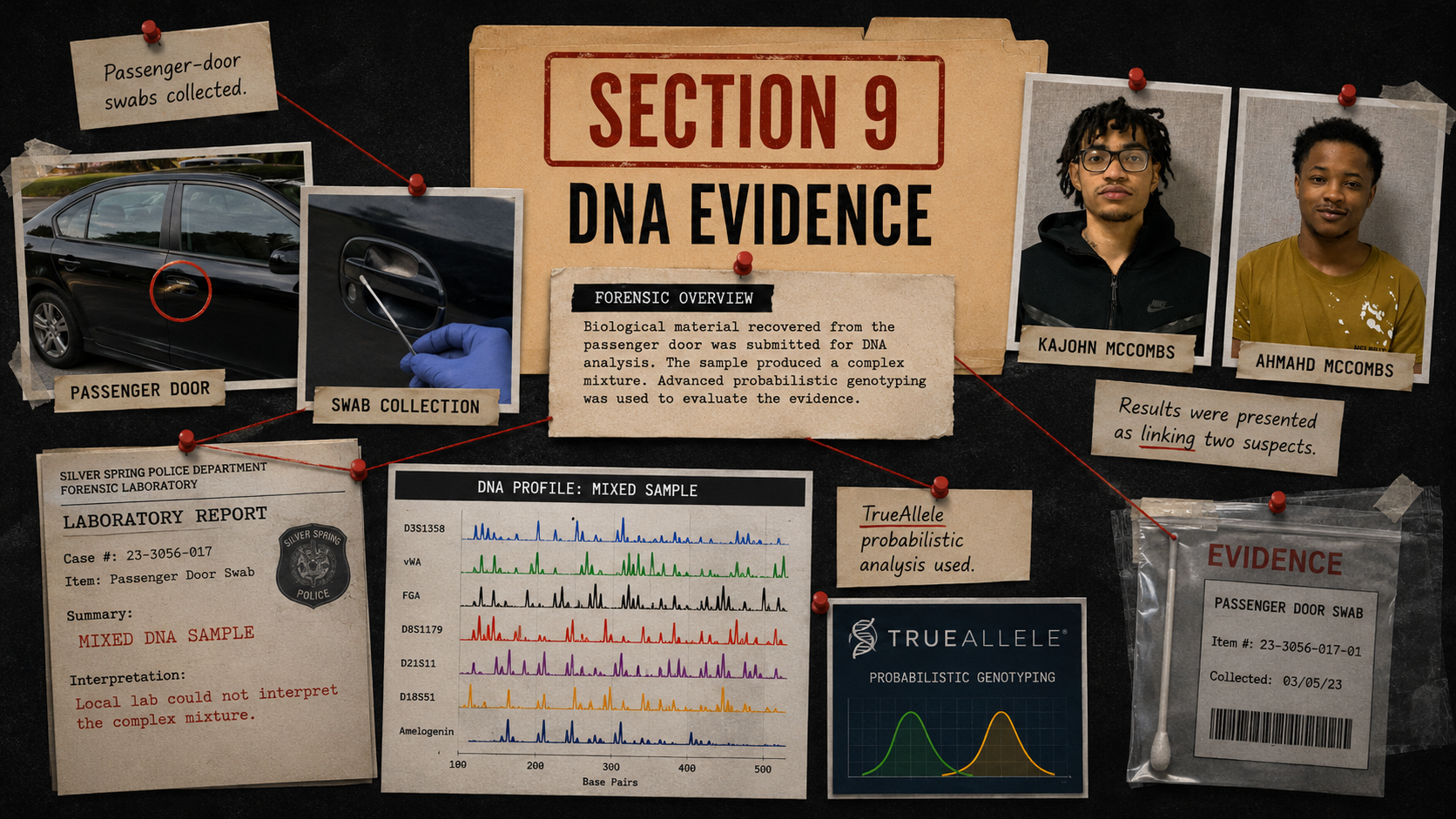
The passenger-door evidence could support an inference that particular contributors had contact with the vehicle, but presence and murder are not interchangeable conclusions. The public record reviewed for this file does not establish when the biological material reached the door, whether every contributor was present during the shooting, or how any particular DNA association proved who fired at Ellis.
Those limitations became especially important because the State’s burden was not merely to show that several men had been around the Honda. Prosecutors had to prove the criminal responsibility of each defendant beyond a reasonable doubt. A mixed sample from a commonly touched area of a vehicle could contribute to that case, but it still required context from other evidence.
The same problem existed with the phones. The alleged digital trail could strengthen a theory of presence or post-shooting awareness, yet jurors still had to determine whether the total evidence established participation in murder. The case therefore depended less on one dramatic forensic discovery than on whether several different categories of evidence could be assembled into a reliable account of what happened inside and around the Honda.
Kajohn McCombs Goes to Trial
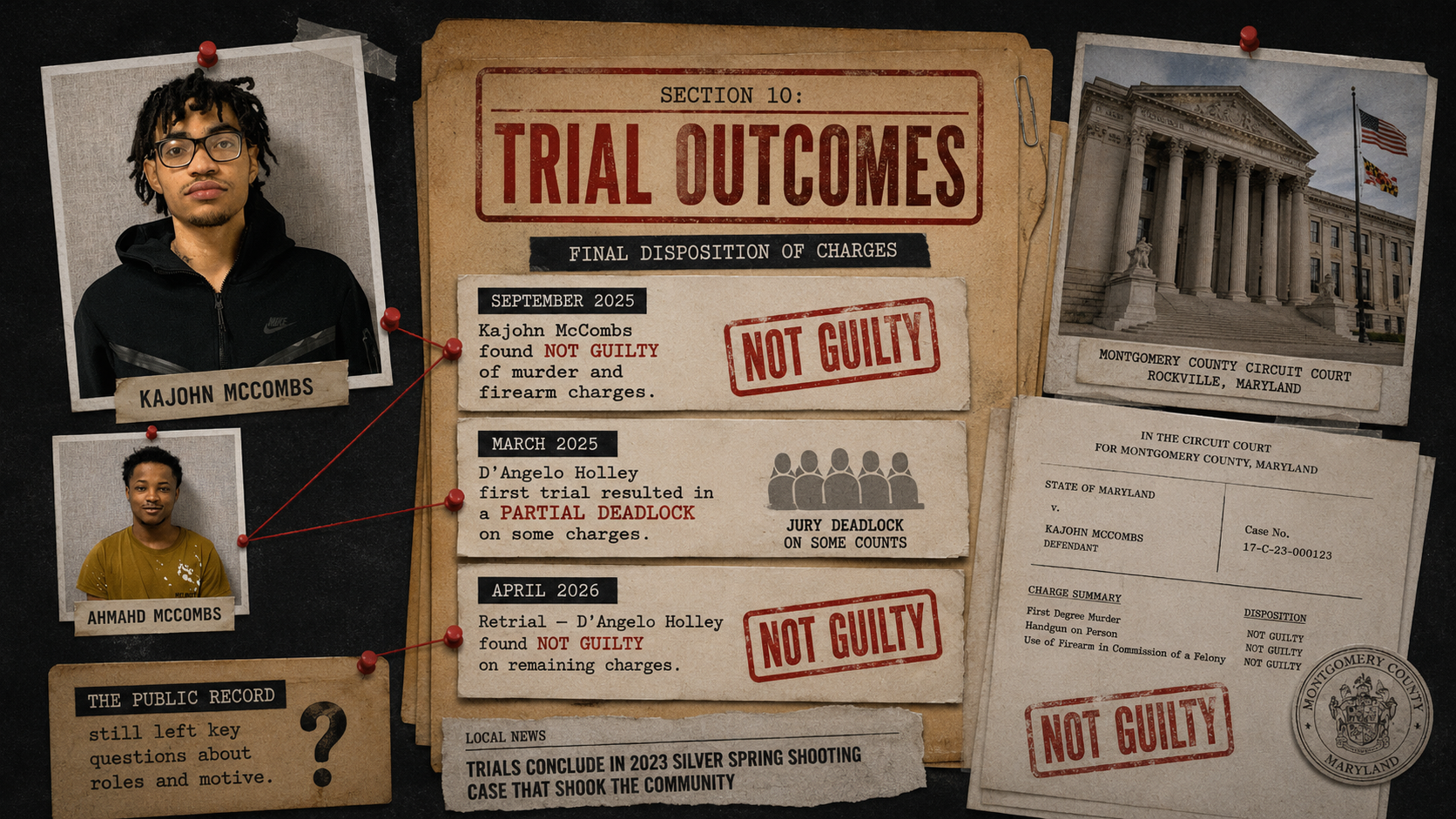
More than two years after Ellis’s death, the prosecution against Kajohn McCombs reached a jury. Cybergenetics states that one of its analysts testified on September 10, 2025, regarding the TrueAllele evidence. Two days later, according to the company’s published case summary, Kajohn was found not guilty of murder and use of a firearm.
The result sharply complicated the original arrest narrative. Investigators had allegedly connected him to the phone found on the passenger floorboard through records and fingerprints, then interpreted a post-shooting call as an effort to locate that missing device. Those allegations had made the phone one of the strongest public pieces of evidence in the case.
A jury nevertheless did not convict Kajohn. The acquittal does not establish that the phone evidence was false, nor does it identify who killed Ellis. It means the prosecution failed to persuade the jury of Kajohn’s guilt beyond a reasonable doubt on the charges submitted. That legal outcome forced a separation between evidence that could justify investigation and evidence sufficient to support a criminal conviction.
For a case built so heavily around the idea of an object accidentally left inside the murder car, that distinction was enormous.
D’Angelo Holley’s Two Trials
Holley’s court outcome was even more complicated. Cybergenetics reports that its analyst testified during Holley’s first trial in August 2025. The jury returned not-guilty verdicts on first-degree premeditated murder and second-degree murder but failed to reach unanimous decisions on first-degree felony murder and use of a firearm.
The split result left the prosecution partially alive. Holley had been acquitted of two homicide theories, while the unresolved counts could be tried again because no final verdict had been reached on them.
The State returned to court in 2026. Cybergenetics states that its analyst testified again during the retrial on April 15, and the remaining charges ended in not-guilty verdicts.
Holley’s outcome therefore unfolded across two juries rather than one. The first rejected part of the prosecution’s case and deadlocked on the rest. The second acquitted him on what remained. By the end of that process, a man once publicly identified as the fourth murder suspect had not been convicted of Ellis’s killing.
The Evidence Did Not Move in a Straight Line
Viewed separately, several parts of the investigation appeared significant. A second phone was allegedly found inside the Honda. Fingerprints and records were said to connect it to Kajohn. Investigators described a call from Ahmahd’s phone to Kajohn’s missing device after the shooting. Surveillance reportedly captured three people fleeing even though a witness described two. Four men were eventually charged, and passenger-door swabs later produced a complex DNA mixture analyzed with TrueAllele.
The difficulty was converting those pieces into a precise account of individual criminal responsibility.
The public record never produced a simple reconstruction identifying one shooter and clearly assigning every other defendant a proven role. Early reporting acknowledged that it was not clear who investigators believed had actually fired the fatal shots. As the case expanded, the prosecution theory apparently became broad enough to encompass several defendants, but much of the detailed reasoning behind those individual charges remained outside the accessible record.
That left jurors with a problem far more complicated than deciding whether certain men had been associated with the Honda. The central issue was whether the State had proven murder.
For Kajohn and Holley, the verified outcomes reviewed for this file show that juries ultimately did not convict.
The Missing Motive
The motive remains one of the weakest areas of the publicly accessible case record.
Material recovered from the Honda reportedly caused investigators to suspect fraudulent prescription-drug activity, but no reliable source reviewed for this file establishes that Ellis was killed over that activity. The available record does not confirm a drug debt, robbery arrangement, retaliation plot, gang conflict, or specific dispute that led directly to the shooting.
That absence creates a major evidentiary gap without requiring a list of speculative theories. The case contains allegations about who may have been around the vehicle and what devices were recovered, yet the publicly available record does not explain why Ellis was shot from behind that night.
A motive is not always legally required for a murder conviction, but its absence can make a multi-defendant prosecution harder to understand, particularly when the identity of the shooter is also unclear in the public record.
The Unresolved Difference Between Presence and Participation
The strongest tension in the Ellis file is not whether investigators found evidence. They clearly did. The deeper issue is what each category of evidence actually established.
A phone on the passenger floorboard could indicate that its associated user had been in the vehicle. A post-shooting call could suggest an attempt to recover that device. Surveillance could document people leaving the area. DNA could support contact with a passenger-door surface. None of those findings, without additional context, automatically proves who decided to kill Ellis or who fired into the back of his head and neck.
The prosecution may have presented more detailed evidence in court than appears in publicly accessible reporting. Even so, the outcomes involving Kajohn and Holley show that at least two juries were not persuaded to impose murder convictions on those defendants.
That is where the file becomes more complicated than the original arrest headlines. The investigation accumulated evidence, expanded to four men, incorporated advanced DNA analysis, and survived long enough to reach multiple trials. The courtroom record still fractured.
The Public-Record Gap Around Ahmahd McCombs and D’Andre Lukes
Two defendants remain unresolved in the accessible record used for this case file: Ahmahd McCombs and D’Andre Lukes.
Their arrests are documented. Ahmahd was taken into custody with Kajohn in March 2023 and charged with first-degree murder. Lukes was later charged through the expanded investigation and arrested in Pennsylvania. What has not been independently established through sufficiently reliable public sources reviewed here is the final disposition of each man’s case.
That gap cannot be filled by assuming they received the same result as Kajohn or Holley. Co-defendants can face different evidence, different plea decisions, separate trials, dismissals, or entirely different outcomes. Until those dispositions are confirmed, the responsible record is that both men were charged and arrested, while their final case status remains unresolved in the sources examined.
The Court Record Changed the Meaning of the Case
The first version of the Deandre Ellis story looked like a rapidly developing murder investigation. Ellis was found shot inside a running car on March 5, 2023. Within nine days, two cousins had been arrested. Investigators allegedly had a phone left behind, fingerprints, call activity, and surveillance. Months later, two more men were accused, and advanced DNA analysis entered the case.
The later court record changed how those facts had to be understood.
Kajohn McCombs was acquitted in September 2025, according to Cybergenetics. D’Angelo Holley’s first jury acquitted him of two murder charges and deadlocked on two remaining counts; a second jury later acquitted him of what remained.
Those verdicts did not solve Ellis’s homicide. They exposed the distance between an investigative theory and proof beyond a reasonable doubt.
Final Breakdown
The Deandre Keith Ellis case began with an image that seemed almost frozen in place: a black Honda Accord on Bonifant Street, engine still running, windshield wipers moving, and a 23-year-old man dead behind the wheel after being shot from behind.
Detectives then found what appeared to be a path outward from the car. A second phone was allegedly tied to Kajohn McCombs. Another device associated with Ahmahd McCombs allegedly called it after the shooting. Surveillance reportedly captured three people fleeing. The investigation widened until four men were facing murder accusations, while passenger-door DNA added another forensic layer to the prosecution.
Yet the final verified court outcomes reviewed here do not confirm the certainty suggested by the early arrests. Kajohn McCombs was acquitted. D’Angelo Holley survived one split jury and a second trial without a murder conviction. The shooter’s identity remains unclear in the public record, the motive has never been firmly established through the sources reviewed, and the final dispositions of Ahmahd McCombs and D’Andre Lukes still require stronger documentation.
The phone left on the passenger floorboard may have helped detectives build the case.
It did not finish it.


