
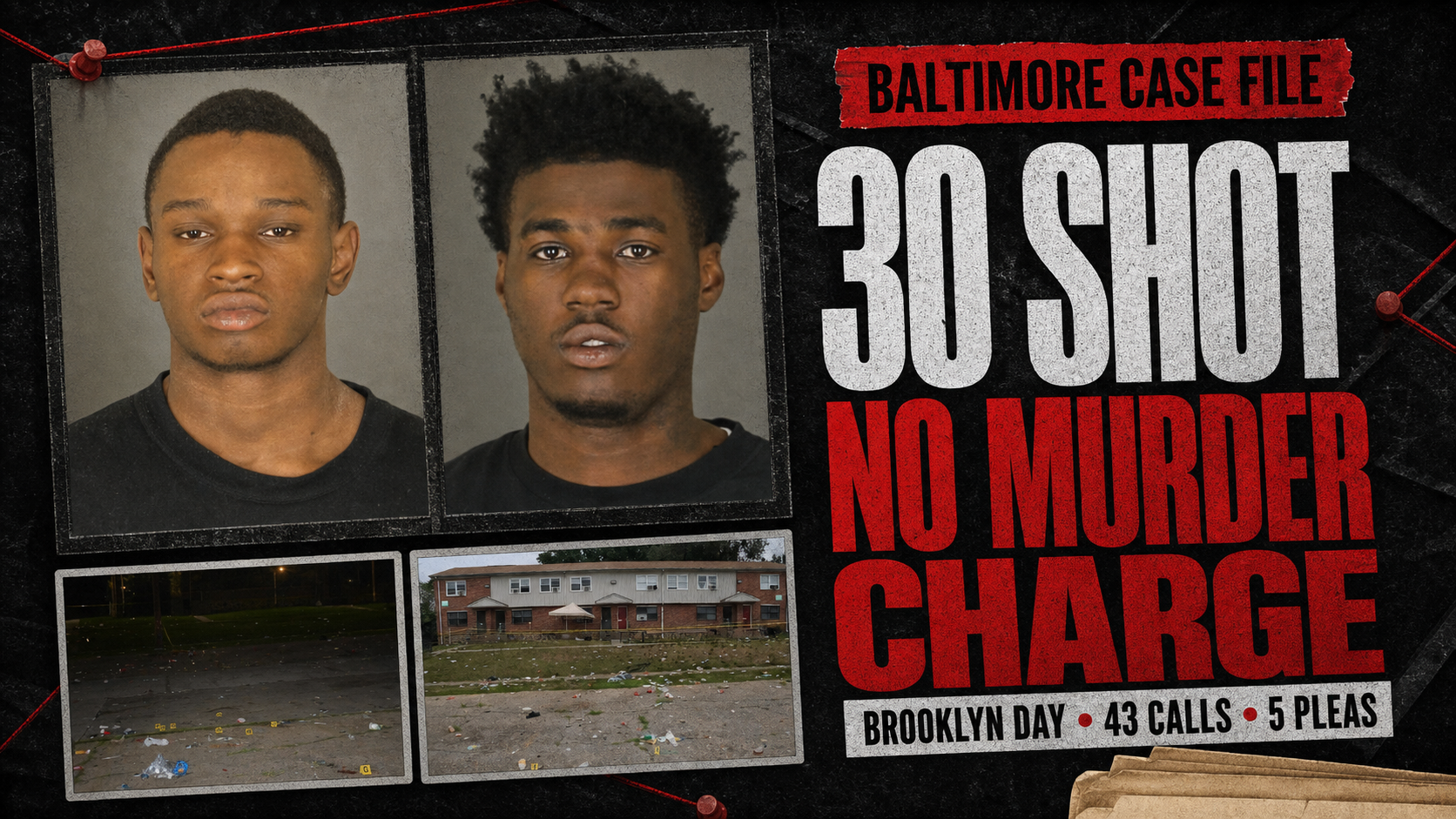
Reporting and analysis may discuss allegations and online theories. Allegations are not findings of guilt. Verify important details in the cited public record.
CASE FILE PREVIEW
Baltimore Brooklyn Day Mass Shooting: 30 Shot, 43 Calls, and No Murder Charge
Forty-three calls entered Baltimore’s dispatch system after the shooting began—but the public record starts hours before the first mass-casualty response. What looked like one burst of gunfire became a citywide emergency involving multiple reported locations, hospital walk-ins, repeated 911 hang-ups, two deaths, and 28 surviving gunshot victims.
The full record is wider than the headline. It includes a 93-page Baltimore Police after-action review, hundreds of hours of camera footage, more than 900 evidence photographs, recovered ballistic material, five prosecutions, and an internal investigation into police planning and command decisions.
One Event, Seven Reported Locations
The first mass-shooting calls were dispatched at 12:35 a.m. on July 2, 2023. Dispatch records identified victims or shooting activity around Gretna Court, Herndon Court, Glade Court, Clintwood Court, Cleve Court, 6th Street, and the intersection of 10th Street and Stoll Place. Other wounded people reached hospitals without ambulances, forcing investigators to build one case from a scene that had already spread across South Baltimore.
The final count was 30 people shot. Aaliyah Gonzalez, 18, was pronounced dead at Brooklyn Homes, and Kylis Fagbemi, 20, died at a hospital. The surviving victims, walk-in reports, hang-ups, and shifting locations explain why the 43-call dispatch picture matters: it shows the scale investigators had to reconstruct without revealing which person fired which shot.
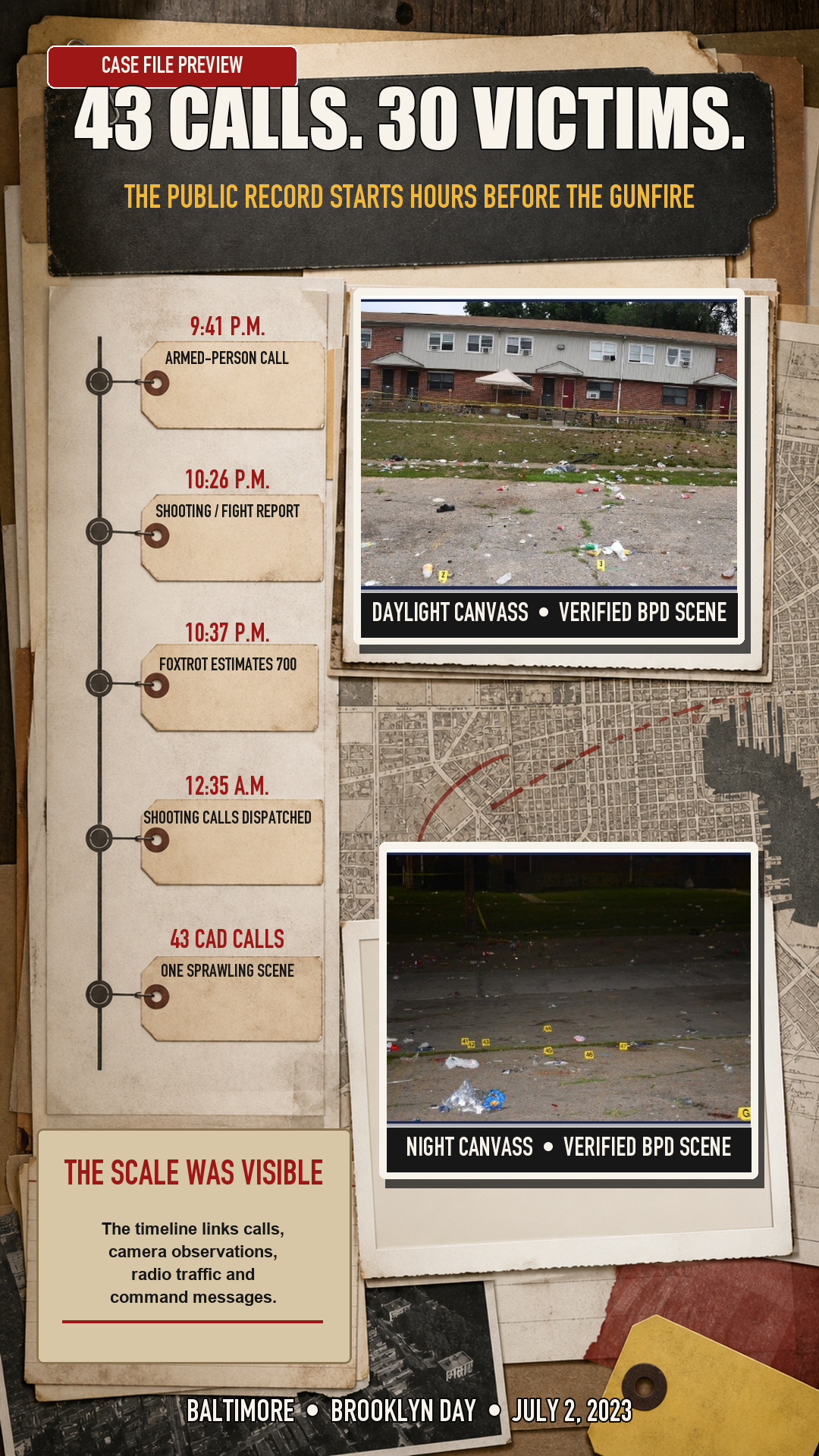
The Warning Timeline Began Before Midnight
Hours before the mass-shooting response, city cameras and officers were already documenting the gathering. A 9:41 p.m. caller reported an armed person and said hundreds of people had guns and knives. A later call reported shooting and fighting, while a police helicopter estimated roughly 700 people and observed fireworks from the air.
The after-action review tracks what happened to those warnings through call assignments, radio messages, camera observations, supervisor decisions, and citywide command notifications. It also records the moment the response shifted from monitoring a crowded event to sending officers, medics, and units from across Baltimore into a mass-casualty scene.
The Evidence Was Collected More Than Once
Detectives and crime-scene technicians worked the area at night and again after sunrise. The daylight canvass and debris removal exposed additional items, and Baltimore Police reported collecting more than 100 objects for possible DNA analysis while creating more than 900 evidence photographs. Clothing, phones, blood samples, cartridge cases, keys, shoes, and other property entered an evidence process that is only partly visible in the public record.
Court reporting later described at least two recovered-firearm links to groups of shots around Brooklyn Homes. Those comparisons are important, but the public documents do not publish the complete casing chart, every laboratory result, or the full path from each recovered item to a particular victim.
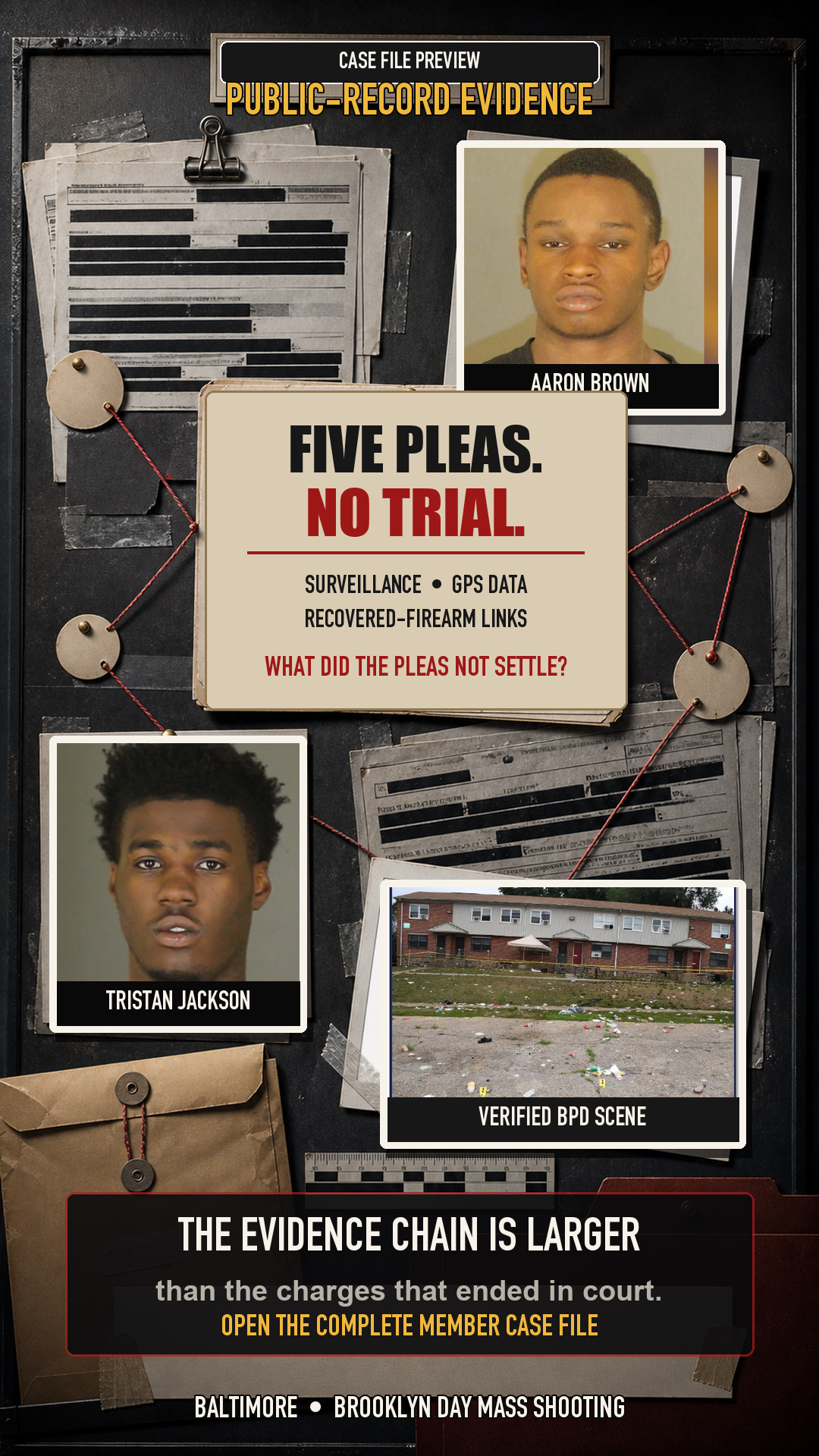
Five Arrests Ended in Five Pleas
Police arrested five people in connection with the shooting, and every case ended in a plea rather than a trial. The two publicly identified adult defendants shown in official Baltimore Police images were Aaron Brown and Tristan Brian Jackson. Their cases drew from different combinations of surveillance, location data, statements, firearm evidence, and alleged conduct around the event.
The plea outcomes established responsibility for specific conspiracy, assault, possession, and firearm offenses. They did not put the entire Brooklyn Day reconstruction before a jury, and they did not publicly test every video sequence, witness account, ballistic comparison, or disputed defense claim in open court.
The Public Record Stops Before the Final Answer
The available files reveal a warning timeline, a massive response, a broad evidence-recovery effort, five case-connected convictions, and a separate administrative investigation into police conduct. They also leave important portions of the homicide case outside public view, including a complete shooter map and the full ballistic path tied to the two deaths.
The complete member case file follows those layers from the first warning through the final plea, separates verified findings from allegations, and shows exactly where the public record becomes incomplete.
Open the complete Baltimore Brooklyn Day member case file
Unlock the full case file.
Continue with the complete investigation, source material, member video, and related evidence.
Unlock Full Case FileMembership starts at $5/month · Secure checkout


